





A workshop should explain which status a badge represents, who holds it and what it covers. Association membership, programme accreditation and a licence are different claims. A logo alone does not establish that a business holds all three, or guarantee a particular repair.
The supporting explanation should match the current status and give customers the relevant way to check it.

No. They are two separate things, and one programme says so on its own page.
The Victorian Automotive Chamber of Commerce publishes its accreditation standards. Its current page says members can choose to enter the accreditation programme. Membership does not automatically establish accreditation.
The signage follows that split. The same page says member signage identifies whether a business is a ‘VACC Member’ or a ‘VACC Accredited Member’. Two signs, two different claims.
A workshop holding membership alone should describe itself as a member. Accreditation requires evidence of that separate status.
Using the stronger word without support can imply a status the business has not established. Confirm its current status rather than relying on an old logo file.
So find out which status the business holds today, then write the sentence to match it.

Accreditation is a commitment to published standards. Describe the particular standards the badge represents.
The chamber’s programme rests on five pillars, listed on the same page. They are the approach to customers, resolving complaints, customer privacy, reducing customer risk, and business competence.
In plain terms, they cover how a business deals with customers and handles a complaint. They also cover customer information, risk to the customer, and how well the business is run. The listed pillars do not amount to a guarantee for a particular repair.
How the standards are tested matters too. The page describes a self-audit, with supporting evidence uploaded. It describes training and random audits checking standards against the documents supplied.
Be clear about what that is not. It is not an independent mechanical inspection of every job, and it is not a warranty on the work.
The sentence beside the badge should identify the programme and describe its scope. For a business holding this accreditation, that could mean explaining its commitment to the published customer-service standards. Avoid turning that into an assurance that every repair has been independently inspected or guaranteed.
Some credentials sit on a public register. That is a different kind of proof, because a customer can look it up without asking anyone.
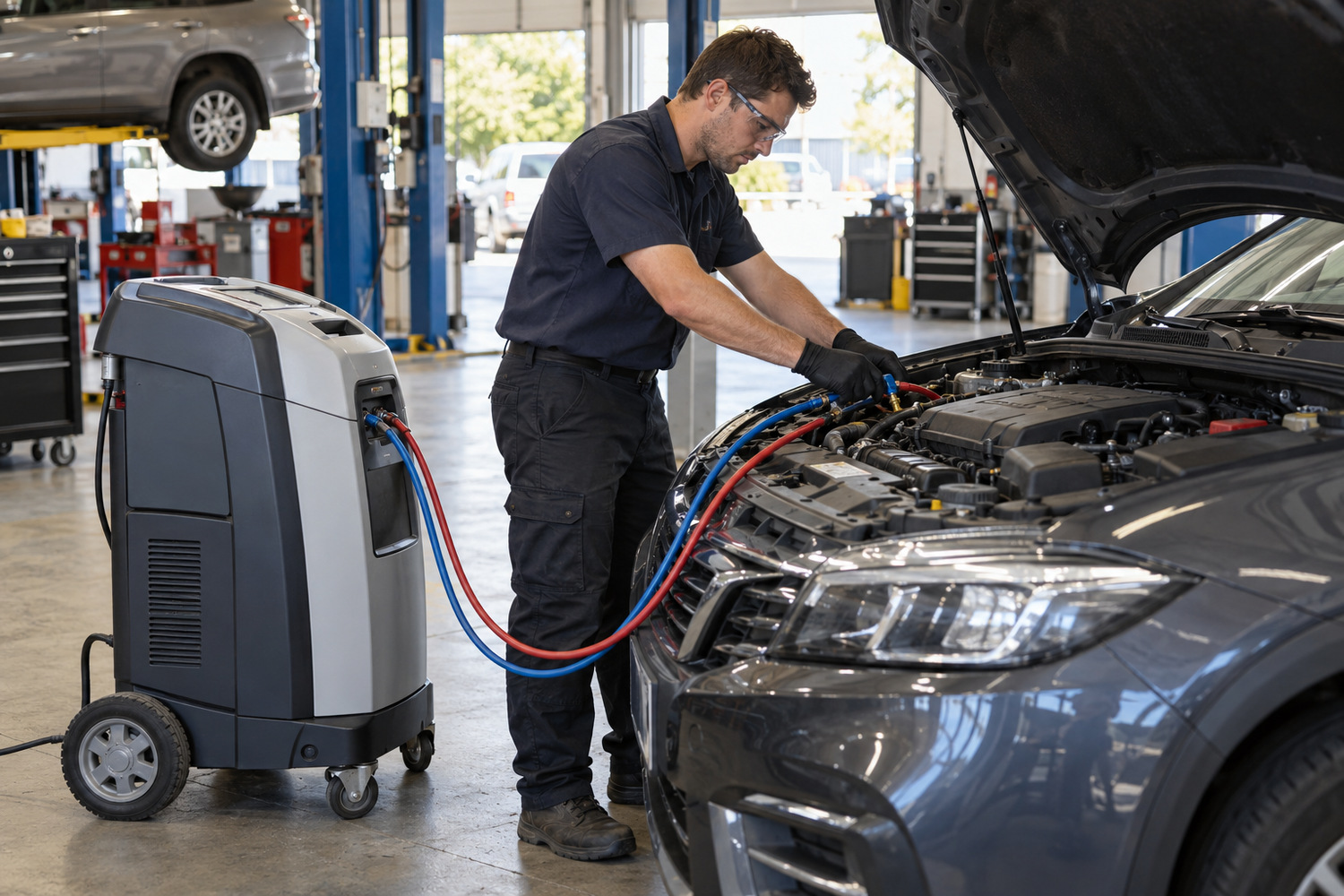
Air conditioning provides one workshop example. The Australian Refrigeration Council runs a public site with two separate routes. One finds an authorised business by business type and suburb, and car air conditioning is one of those types. The other checks a refrigerant handling licence. The licence-check page accepts a technician’s licence number or first name and surname.
The two routes answer different questions. The site distinguishes sectors and licence types. A business listing and one person’s refrigerant handling licence are not the same fact.
What the check returns is narrow. The licence page says the search will advise whether the licence is current. It also reports what type of licence the technician holds.
The council also states that it does not guarantee a licence holder’s work or products. A current licence result establishes the holder and type reported by that check. It is not a guarantee of workmanship or evidence of permission for unrelated work.
Identify whether the claim concerns a business authorisation or an individual licence. For example, a hypothetical workshop employing a licensed air conditioning technician should not imply that every technician holds that licence. The explanation belongs with the relevant service, without extending it to unrelated repair work.

Put enough explanation beside a badge for a customer to understand the claim. If the logo appears in a footer, link it to the relevant status information rather than relying on the image alone.
A membership logo, accreditation mark and licence reference can appear together while referring to different holders and standards. Label those differences so their scope remains clear wherever they appear.
Badges are only one part of what a page has to get right. The piece on mechanic website enquiries covers the rest of that ground.
Give the supporting explanation where the relevant work or commitment is described. Membership belongs on the page that explains who the business is. The refrigerant licence belongs on the air conditioning page. Accreditation belongs beside the commitments it covers, such as how a complaint is handled.
Then write the line that goes beside it. One sentence says what the badge covers, who issued it, and where a customer can check it. A logo without context can leave its meaning unclear.
Do not let a supplier’s logo imply manufacturer approval of the workshop’s repairs. A supply relationship and an approval programme are separate claims, and either needs its own evidence.
Broader advice on website proof for trade businesses sits in a separate piece, because much of it reaches well beyond a workshop.

A status the business can no longer support has to come off the website, and the programme may require it.
The chamber’s page says a member who ceases to meet the accreditation standards ‘will be required to remove all accreditation signage’. It separately describes a rectification process. Where a member is not complying, the programme allows a set period to put it right. If nothing is done in that period, the business leaves the accreditation scheme. Read the current page before you quote any of it. A programme can change its own rules.
Check website references as well as physical signs. A footer logo or service-page badge should not keep implying a current status once the business can no longer support it. Assign responsibility for keeping those references accurate; follow the programme’s current requirements rather than inventing a universal deadline.
A workshop may hold no optional accreditation. Inventing one is the worst answer available. So is copying a programme’s mark the business has no right to use.
Factual service and qualification information can stand on its own without being presented as an accreditation. Describe the work the business accepts and identify any relevant current licence accurately. General advice on project evidence belongs in the separate trade-website article.
Here is a test worth running on your own site this week. List every logo that appears on it. Beside each, write the sentence that says what it covers and who issued it. Add whether a customer can check it. Where the status or scope cannot be established, investigate before continuing to present it as current. Where it can, give the customer that explanation rather than keeping it only in internal notes.
Use the check offered by the particular programme. Reading its standards explains what accreditation covers, but does not confirm a named business currently holds it. A register result and programme confirmation provide different evidence, and the website should identify the applicable route.
An individual licence result concerns that person. It does not establish whether the business holds a separate authorisation, and the wording should preserve that distinction. A check by name returns one individual and the type of licence they hold. A page implying that everyone on the floor is licensed for that work claims more than the register would support.
It says which association the business has joined. In the VACC example, accreditation is a separate status tied to the published standards. Neither membership nor that accreditation is evidence that an individual repair has been independently inspected. Membership is a fact about affiliation, so a website should present it as one.