






Advertise the jobs where one booking is worth many clicks. Run the ads only while somebody can answer the phone. Send the click to a page about that job rather than to the home page. That usually leaves a short list, because ordinary search and your Google Business Profile already bring some of it in.
Somebody has told you Google Ads will fill the bays. Google Ads for mechanics is not one yes or no. It is a list of jobs, and only some of them are worth a paid click.
This is written for the owner of an independent workshop with a few people on the tools. You do brakes, logbook servicing, roadworthies, air conditioning, auto electrical work and diagnostics. One shop, one address, one phone that somebody has to answer.

A search ad is a paid listing at the top of a Google results page, marked Sponsored. You pay when somebody clicks it. You do not pay for the booking. The click is charged either way.
The gap between the click and the booking is the whole decision. What settles it is what one booked job is worth to you, against what it costs to win one. Clicks that never turn into a call still come out of the budget.
Nobody can give you that number from outside your shop. It rests on your labour rate, what you make on parts, and how many callers end up in a bay. An industry average is a guess about somebody else’s workshop.
If you have not decided to spend anything on marketing yet, start further back. Our piece on where a small business should spend its first marketing dollars sets out the order.
How much of a budget belongs in advertising at all is a separate question. Our guide to balancing SEO and Google Ads spend answers that one. This article stays on the jobs.

Sort your own jobs before anybody shows you a keyword list. The split that matters is between work a driver shops on price and work where one booking carries a week.
A driver ringing round for the cheapest roadworthy is comparing numbers. You can win that click and still lose the job on the phone. You paid for it either way. Repair, diagnostic and specialist work behaves differently. Somebody whose car pulls to one side under brakes wants it fixed properly and fixed nearby.
Three questions sort your list faster than any tool. What was this job worth on the invoice? Would a driver type its name into Google? Could you take more of it next week without turning other work away? A job that fails the last question does not need advertising.
One complication is the cheap job that leads to the work that pays. A roadworthy finds the brakes. A diagnostic fee turns into a repair. Judge those jobs by where they lead, then check the invoices.
The other complication is the job that fills a bay that was going to be full anyway. In a booked-out week, an ad buys work you would have had. Ads earn their keep where there is room in the diary.

An ad schedule sets the days and hours your ads are eligible to show. Google’s own help page puts the choice plainly. Your ad can show whenever a customer searches, or only on certain days, or during the business hours when you are there to handle enquiries. A campaign shows ads all day until you change it.
A call ad shown at nine on a Friday night is a paid missed call. The click is charged. The caller rings somebody else.
An ad schedule is not a way to spend less. Google states that with a schedule in place, campaigns pace toward a monthly spend of 30.4 times the average daily budget. That holds whatever number of days the campaign is active that month. Narrower hours concentrate the same money rather than saving it. Google also points out that if nobody searches in the window you scheduled, your ads will not show.
The early window is often the one worth holding. Drop-offs get decided the night before or over breakfast.
What happens to an enquiry that lands after hours has its own answer. Our piece on mechanic bookings by phone or form covers the evening enquiry and the morning routine that catches it.
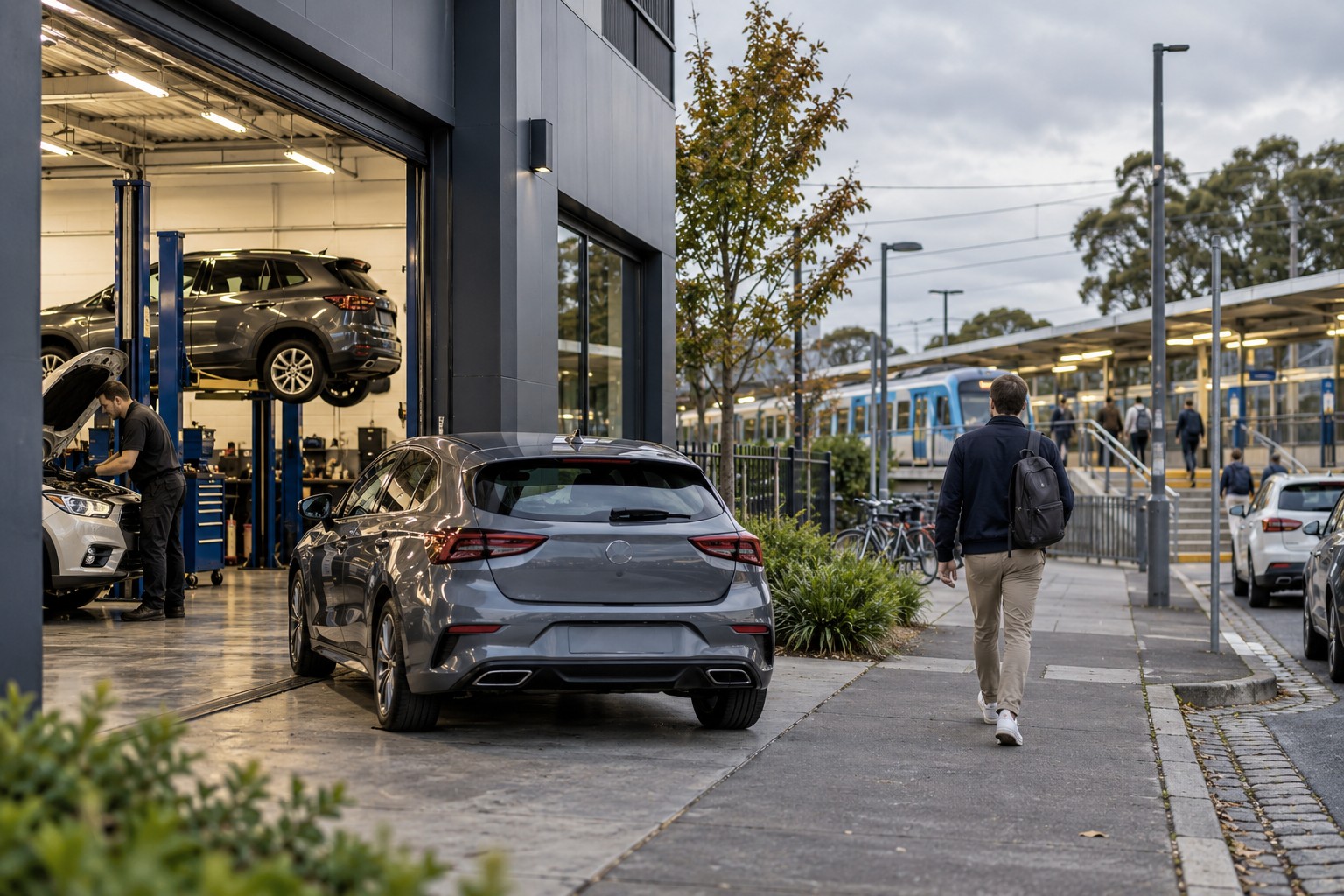
Location targeting decides where an ad is eligible to show. You can point it at a country, at areas within one, or at a radius around your address.
Google sets one hard limit. Radius targeting needs a radius of at least 1 km around a location, and anything tighter is not allowed. Google warns that a very small radius or location can mean ads show intermittently or not at all, because small targets may not meet its targeting criteria.
The rest is your judgement, and the real question is not distance. It is how somebody gets on with their day after dropping the car off. A workshop beside a Melbourne train line can pull customers from several stations away. They leave the car and walk to the platform. A shop in an industrial pocket with no bus is working within the range of a mate in a second car.
Google’s own advice is to target where your customers are, rather than only where the business sits. It also says targeting rests on a variety of signals and is its best effort, with 100% accuracy not guaranteed in every situation. Treat the map as roughly right.
There is no correct number of kilometres. Anyone who gives you one before asking how your customers get home is guessing.

A landing page is the page a click arrives on. A click about one job should land on a page about that job. The home page makes the driver go looking, and some will leave instead.
Google rates the landing page through Quality Score. It is built from three parts: the expected click-through rate, how closely the ad matches the intent behind the search, and landing page experience. Google describes that last part as how relevant and useful your landing page is to people who click your ad. Each part is rated above average, average or below average, against other advertisers whose ads showed for the exact same search over the previous 90 days.
The limit matters as much as the fact, and Google states it on the same page. Quality Score is not a key performance indicator. It is not an input in the ad auction. Google calls it a diagnostic tool. So a tidier landing page is not a lever that buys cheaper clicks. Send the click to the right page for the plainer reason: the person who clicked wants that job done.
In practice that means the service page for the job in the ad, or a page built for the campaign. Which pages your site needs is a bigger question than this one.
All of this belongs to search campaigns. If your ads run as Performance Max, a different campaign type, and the cost of an enquiry keeps climbing, our piece on Performance Max cost per lead is the one to read.
If calls stay thin wherever the click lands, the site may be the problem. Our article on why a mechanic website does not get enough calls goes through the usual faults.

Ads are rented attention. Stop paying and the enquiries stop that day. What you own keeps working: your pages, your reviews, the customers who already know you.
Some jobs get paid for twice. You may already come up in ordinary search for logbook servicing, with the phone ringing from your profile as well. An ad on that job buys calls you had. Ads against your own business name are the clearest case.
Before you cut anything, count the right thing. Booked jobs, not clicks. Then check whether the calls are for the jobs you chose, or for the cheapest item on the list. Pause one job for a fortnight and watch the phone. Bear in mind that a quiet fortnight in a trade with seasons proves less than it looks.
Your profile may be bringing in more of this work than you think. Our guide to Google Business Profile tips that get mechanics more calls covers what to keep current.
Pull last quarter’s invoices this week. Rank the jobs by what each one was worth to you, then mark the three you could take more of tomorrow. Advertise those three and nothing else for a month. If you would rather somebody else ran that, CJ Digital’s Google Ads page sets out how the work is charged.
For some of its jobs, yes, and for the rest it is money spent on attention the workshop already had. The test is whether a single booking is worth more than the clicks it takes to win it, and that figure sits in your own invoices rather than in anybody’s industry average.
The jobs with enough in one booking to cover the clicks that go nowhere, and enough room in the diary to take more of them. Work that drivers ring around to price is the weakest candidate, because winning the click there does not win the job.
Only when something answers. A click after closing time costs what a click in the morning costs, so what matters is where that enquiry goes before you open. If nothing catches it overnight, the honest move is to narrow the hours you pay for.
As far as somebody will still hand over the car and get on with their day. Trains, buses and whether a mate can follow them decide that, which makes it your call rather than a set distance. The only fixed rule is Google’s floor of a one kilometre radius.
On the page about the job named in the ad, so the driver reads about the thing they searched for. Send them to the home page and they have to hunt for it, and a share of them give up rather than hunt.