





At 5.47 pm on a match night, two friends leave Richmond Station looking for dinner. One restaurant has a free table, but its website offers a PDF menu, vague hours and no booking link. Another shows a 6 pm table, the kitchen closing time and a seven-minute walk from the station. The second venue gets the booking before either person reaches Swan Street.
Good web design in Richmond starts by recognising that the suburb is not one market. A Swan Street venue, a Bridge Road clinic and a Victoria Street grocer share a postcode, but not the same customer decision. The site has to make that decision easy instead of relying on the suburb name to carry the message.
That difference becomes clearer street by street.
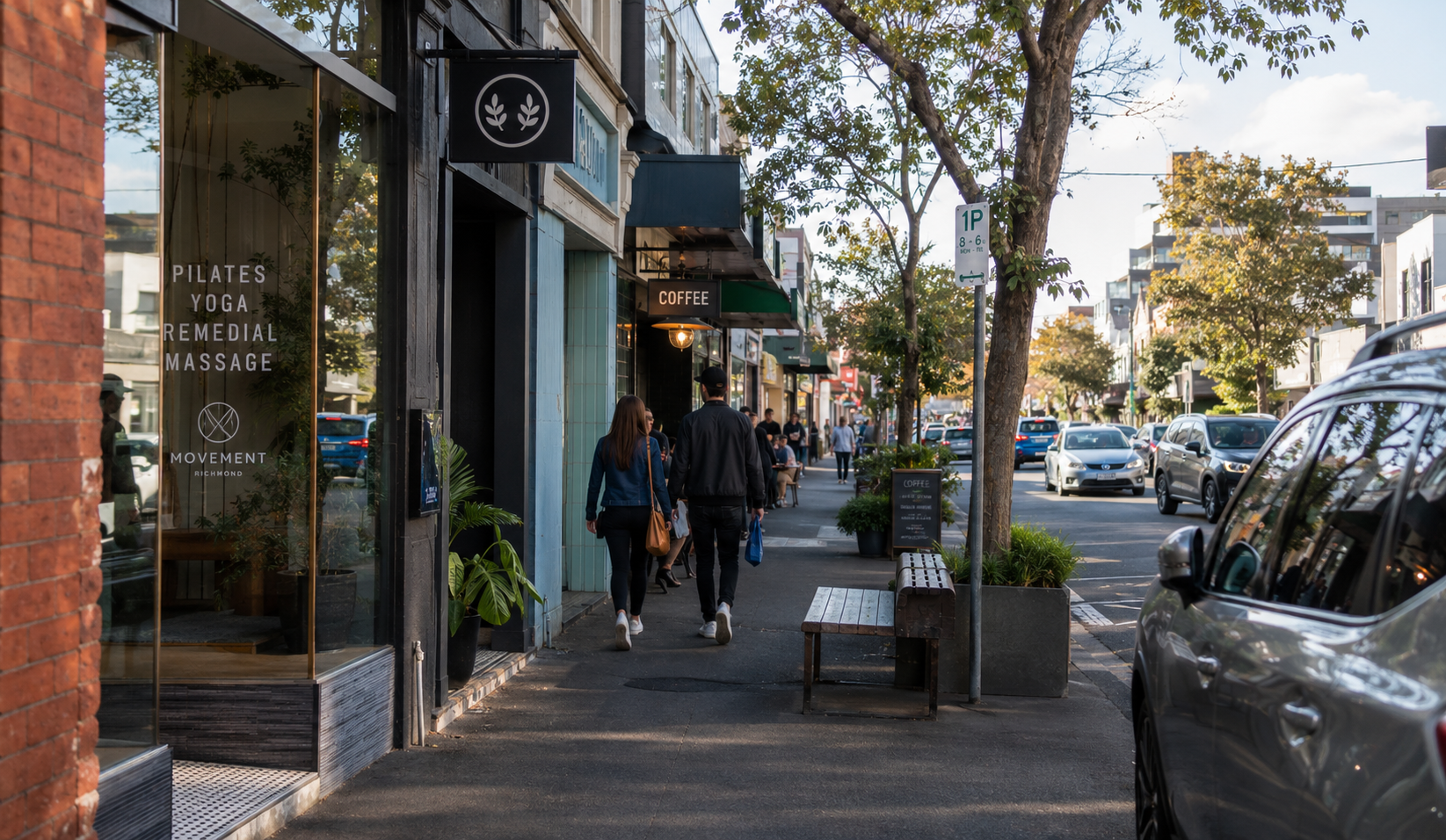
Richmond compresses several business settings into a small area. Swan Street carries food, nightlife and event traffic from the sports precinct. Bridge Road now mixes retail and hospitality with homewares, beauty, health and allied services. Victoria Street remains a food and fresh produce destination with a strong Vietnamese identity. Service businesses and trades work from pockets between the main strips.
Those settings create different moments of judgement. A person choosing dinner before a game needs a fast answer about time, distance and a table. A patient comparing clinics needs practitioner details, appointment types and access information. A household looking for a trade needs proof of relevant work, a clear service area and a quote path that does not waste an evening.
Business type sets the main website job. The street changes the supporting detail. That rule travels beyond Richmond. Local design works when the place changes the decision, not when local names merely decorate the page.
Cremorne's office precinct needs a different website. Software firms, creative studios and consultancies are covered in the sibling article, Web design for Cremorne's tech and creative businesses. Richmond's trading strips need a site built around visits, bookings, appointments and local service enquiries.
Swan Street has a strong before-and-after pattern. Yarra City Council describes it as a food and nightlife destination near the Melbourne Sports and Entertainment Precinct. Richmond and East Richmond stations and the route 70 tram serve the strip. A venue can move from a normal weekday trade to a sharp event-night rush without changing its address.
The website has to answer the time-sensitive questions first. Current opening hours, kitchen times, booking availability, menu details and the easiest way to arrive should sit close together on a phone. A generic 'open late' line is weak when the customer is working backwards from a siren, concert start or train home.
Event traffic also creates a risk. A promotion can draw attention while the basic details remain stale. When hours, booking rules or access change for a major event, the website and Google Business Profile need the same update. One wrong closing time can undo the value of a full page of polished photography.
Retailers and service businesses on Swan Street face the same test in a different form. A customer should be able to confirm stock categories, appointment times, pickup options or event-day changes before joining the foot traffic. The page must help with the visit, not merely announce that the business exists.
The postcode is the same. The decision is not.
The old picture of Bridge Road as a line of fashion outlets no longer explains the strip. Current trader material points to a broader mix of cafes, restaurants, furniture, homewares, gifts, hair, beauty, health and wellness services. Epworth and nearby allied health businesses add another daily audience that has little to do with bargain shopping.
That shift changes what the website needs to do. A homewares showroom needs product ranges, dimensions, delivery information and clear showroom hours. A clinic needs named practitioners, service details, referral information where relevant, online booking and practical access notes. A cafe needs current menus and trading hours. A financial or professional service needs a calm explanation of the work and a direct enquiry path.
Bridge Road businesses can no longer assume the street's old reputation will explain them. The site needs to state what kind of visit is on offer now. It should also separate several very different offers when they share a building, such as a ground-floor shop, upstairs clinic and professional suite.
The strongest local proof is practical. Show the entrance, say which level the business occupies, explain lift or stair access and name the closest useful transport stop. These details may look minor in a design mock-up. They become decisive when someone is choosing between two appointments or showrooms.
Victoria Street carries more cultural meaning than a generic hospitality strip. It sits on the Richmond and Abbotsford border and is widely known as Little Vietnam, alongside Chinese, Thai and Korean food and fresh produce. A useful website should keep that identity specific rather than flattening it into stock images and broad claims about Asian dining.
For a restaurant, grocer or food business, detail does the work. Show the current menu or product range, service style, dietary information, ordering options, opening hours and recent photographs of the real premises. Some businesses regularly serve customers in more than one language. Key booking, ordering or contact details can then appear in those languages without turning the whole site into a translation project.
Victoria Street also faces documented problems with safety, amenity and economic confidence. A website cannot fix street conditions. It can remove avoidable uncertainty by showing the exact entrance, pickup process, public transport, trading hours and who to contact when plans change.
That is not a reason to write defensively about the area. It is a reason to be precise. Current information gives a customer a stronger basis for a visit than a page that relies on reputation alone.
The most useful page order follows the decision closest to revenue. A gallery, an origin story and local photography may still matter. They sit behind the task that brings a booking, visit or enquiry.
| Business setting | Decision the site must support | Information that earns its place |
|---|---|---|
| Strip hospitality and retail | Is it worth visiting now? | Current hours, menu or stock range, booking or pickup, event-day changes, access and real premises photos |
| Allied health and clinics | Is this practitioner or service right, and can I attend? | Practitioner profiles, service scope, referral details where relevant, booking, accessibility and entrance information |
| Services and trades | Can this business handle my job and respond clearly? | Service area, job types, relevant project proof, licences where required, quote path and response expectations |
The table is not a feature list. It is a way to stop the homepage from trying to serve every audience at once. The main action should be obvious, while secondary details sit where they help rather than compete.
Local visibility in Google is not produced by the website alone. Google says local results are mainly shaped by relevance, distance and prominence, and it recommends complete, accurate Business Profile information. A site can strengthen relevance and credibility, but it cannot change the customer's distance or guarantee a map position.
Richmond businesses should keep the profile and website aligned. The business name, address or service area, category, phone number, hours and main offer should match. Restaurants can add menu, reservation and ordering links. Health and beauty businesses can add services and booking links. The profile should lead to a page that confirms the same facts rather than creating a second version of the business.
A business serving several Richmond strips does not need a thin page for each street. One developed Richmond page can explain the genuine service area, premises, access and local work. Separate pages earn their place only when there are separate locations, different offers or enough local detail to help someone make a different decision.
Google's spam policy treats substantially similar location pages that funnel visitors to the same destination as doorway abuse. The practical test is simple: remove the street name. If the page says nothing useful after that, it was not a local page in the first place.
Richmond's strips are still being reshaped. In 2026, Yarra City Council was preparing a Victoria Street Revitalisation Plan focused on amenity, safety and economic activity. Council had also adopted updated planning controls for Bridge Road and Victoria Street and submitted them to the Planning Minister.
A website can become locally wrong before it becomes technically old. The business mix changes, access changes, new residents arrive and a street's reason for visiting shifts. Pages need a structure that lets the business update hours, services, practitioner details, events, transport and local photographs without paying for a rebuild each time.
A useful first step is to write one sentence for the decision each main page must support. A website review with CJ Digital can test the current site against those jobs. It can keep what still works and show where local detail has gone stale. Review the web design work, then send the current URL through the contact form.
No. The designer needs to understand how the business works and how the local setting changes the customer decision. Proximity helps when street access, photography, premises layout or face-to-face planning affects the finished site. It adds little when the project can be understood and managed remotely.
The suburb does not set the price. Cost depends on page count, design work, copy, photography, booking or ecommerce features, integrations and the condition of the existing site. A Richmond restaurant with online ordering may need more work than a professional service with five clear pages, even when both occupy similar premises.
Yes, when the business genuinely serves customers across Richmond. The site should organise information by service or customer task, then use local detail where it changes access, timing or proof. It does not need three copied pages with different street names.
Usually not. A separate page is useful for a distinct premises, a different offer or substantial local information that changes the visit or service. Thin pages that repeat the same copy add little for customers and can fall into Google's doorway-abuse rules.
A complete and accurate Google Business Profile is the base. Keep the address or service area, category, hours, phone number and website current, then support the profile with relevant site content and genuine reviews. Distance remains outside the business's control, so no website can promise a map position.