





At 4.40 on a Friday afternoon, a parent steps off the train at Fairfield with one birthday present left to buy. A shop on Station Street has been recommended in the school group chat. Its website has polished photos, but no current opening hours, product range or phone number in sight. The parent buys from a chain on the way home. The shop had the local recommendation. It lost the visit when a first-time customer needed practical information.
A strong local reputation does not carry itself onto a screen. Good web design in Fairfield turns word of mouth into a visit, booking or enquiry by making the basics plain: what the business does, who it is for, when it is open, where to go, and what happens next.
We have focused on Fairfield in Melbourne here as an example, but the lesson travels beyond Fairfield. Familiarity is an advantage only after the website turns it into information a new customer can use.
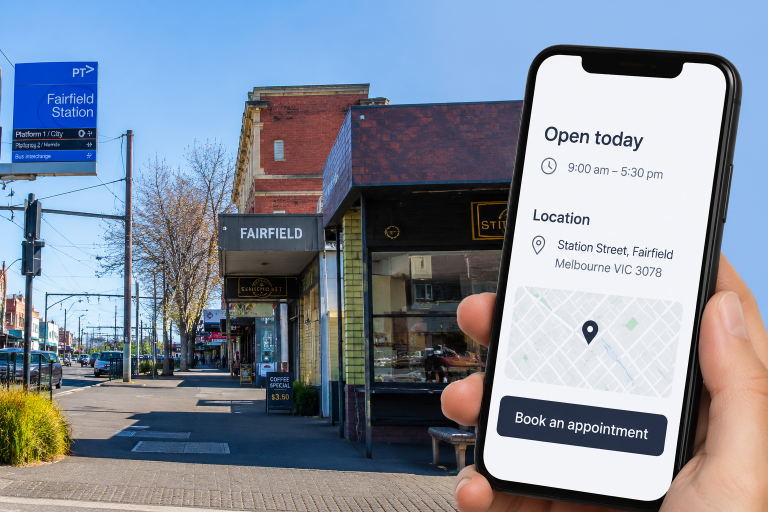
On Station Street, regulars already know which cafe fills first on Saturday, where a side entrance is, and which shop will hold an item until closing. A first-time visitor knows none of that. Fairfield's commercial centre takes in parts of Station Street, Wingrove Street and Railway Place, with the station reserve helping give the strip its compact village scale. The website has to carry the practical knowledge that usually moves between neighbours by recommendation.
That is a different job from displaying a logo, a few photos and a general promise of good service. A cafe needs current trading hours, a menu and a clear booking or walk-in position. A shop needs to show its range well enough for someone to decide the trip is worthwhile. A clinic needs to explain who treats what, how appointments work and how to enter the building. A local service business needs to make its scope and service area clear before someone spends time on an enquiry.
Fairfield is predominantly residential, while the village directory spans food and dining, retail, business services, health and wellbeing, and specialty traders. Many businesses depend on repeat local custom, yet growth often comes from the person visiting for the first time.
Regular customers can fill in the gaps. First-time customers cannot.
Business type sets the website's main job. Fairfield changes the supporting detail. A cafe that hides its menu and a clinic that hides its practitioners have the same surface problem, but not the same fix. One needs speed and certainty around a visit. The other needs trust and a low-friction path to an appointment.
| Business type | Website's main job | What it must make clear | Useful Fairfield detail |
|---|---|---|---|
| Hospitality and retail | Turn a recommendation or passing interest into a visit, booking or order. | Includes local hosting, 1 monthly hour, backend maintenance, account support and quarterly check-ins. | Exact Station Street or Railway Place location, entry details, holiday hours and collection instructions. |
| Allied health and professional services | Reduce uncertainty and help someone choose the right service or practitioner. | Services, practitioner profiles, qualifications, fees or referral details where relevant, and online booking. | The correct entrance, accessibility, stairs or lift, nearby transport and what to bring to an appointment. |
| Trades and local services | Show that the job is a fit and make a useful quote request easy. | Service scope, work examples, licence details where relevant, service area and realistic contact expectations. | Real coverage across Fairfield and nearby suburbs, without copied pages that only swap place names. |
A trade business may not need a shopfront at all, but it does need to show that an enquiry sits inside its real service area. A retailer may not need full ecommerce, yet a useful product range can stop a customer assuming the right item is unavailable. A clinic can have excellent practitioners and still lose an appointment if the booking path is hard to find on a phone. Local detail earns its place when it removes one of those doubts.
A website supports local visibility by making the business easy to understand and consistent with its Google Business Profile. Google says local results are mainly based on relevance, distance and popularity. A website cannot move the premises closer to the person looking, and no agency can buy a better local position. It can make relevance clearer and give Google stronger public information about what the business does.
The basics need to agree across the site and profile: business name, address, phone number, hours, service categories and booking links. A restaurant page that says dinner is available while the profile closes at 3 pm creates doubt. A clinic page with an old practitioner list does the same. A trade site that claims all of Melbourne but gives no service boundaries makes the offer less useful, not more impressive.
Reviews add current proof of customer experience, but they cannot repair missing hours, unclear services or a broken form. A steady flow of honest reviews works best when the profile and website tell the same clear story. Fairfield's own village directory separates traders into practical categories such as food, retail, business services, and health and wellbeing. A business website needs the same category clarity before local signals can do much work.
The costliest local website mistakes are usually ordinary. They show up when someone is close to acting and cannot confirm one final detail. A regular customer may know the answer from habit. A new customer closes the tab.
One developed Fairfield page can explain the real location, access, service area and local business setting. Ten pages that only exchange one suburb name for another do not add that value. Google classifies substantially similar regional or city pages that funnel people to one destination as doorway abuse. The stronger approach is to write a local page only when the place changes the service, the visit or the decision.
The Station Street shop from the opening did not need a large online store to save the sale. A current range, visible hours and a direct phone link may have been enough. The useful fix is tied to the lost decision, not to the number of features a website can carry.
A website build becomes expensive when page design starts before the business has decided what the site is responsible for. For a Fairfield cafe, the main action may be a booking or a visit. For an allied health practice, it may be choosing a practitioner and securing an appointment. For a trade, it may be a quote request with enough detail to judge the job. The design should make that action clear before it adds animation, video or long brand copy.
Control and upkeep also need to be settled early. The business should know who controls the domain, hosting, site files, content and email records. It should also be clear who updates public holiday hours, staff profiles, menus, prices and urgent notices. A site that needs a long support exchange for every small change will become stale, even when it looked polished at launch.
Professional work earns its fee when the project goes beyond page styling. Structure, content migration, booking or form integrations, speed, tracking, accessibility and a clean handover can affect the finished result for years. A simple business with one service and one action may need a modest site. The right scope is the smallest one that makes the first customer decision easy and leaves the business in control.
Fairfield Village is being treated as a place with a character worth keeping. Council planning work describes a low-scale centre shaped by traditional buildings, local businesses, accessibility and open space around the station reserve. The traders association is also promoting the centre as a group, with a live directory and village events.
Online, that shared identity can become a trap. If every shop, clinic and service uses the same template and the same broad claims, the village name does all the work while the individual business remains hard to choose. As Fairfield keeps its compact local scale, its businesses will need to become more specific online, not less. The first test is not whether a site looks local. It is whether a stranger can use it.
Open the current site on a phone and approach it as someone stepping off the train for the first time. If the offer, hours, location or next step is missing, that gap belongs at the top of the brief. CJ Digital can turn it into a practical plan through its Melbourne web design service, or you can contact the team to book a website review.
No. A dedicated Fairfield page is useful only when it contains local information that changes the visit, service or decision. A business with one premises may be better served by a strong location page with accurate access, hours and contact details. Businesses covering several areas should create separate pages only when each area has genuinely different information.
No. Google says local results are mainly based on relevance, distance and popularity, and there is no way to request or pay for a better local ranking. A clear website, complete Business Profile and honest reviews can support visibility. None can guarantee a position for every person or location.
Not always. A local shop can make a first visit easier by showing its main product categories, featured items, price cues, pickup options and a direct contact method. Full ecommerce makes sense when the business can keep stock, payments, delivery and returns accurate. A neglected online catalogue can create more doubt than a smaller current range.
Sometimes. One page can work for a simple business with one service, one audience and one clear action. Separate pages become useful when the business has distinct services, practitioners, locations or evidence that needs room to be understood. The page count should follow the decisions the site has to support.
Check them whenever hours, staff, services, prices, menus, booking links or access details change. A quarterly review is a sensible minimum for a stable business. The same check should cover the Google Business Profile, contact forms, phone links and the mobile version of the site.