




A Model Y in a Blackburn driveway is due for its first real service. The owner books the dealer. Not because the dealer is closer, or cheaper, or better. Because it never occurred to them there was a choice. The workshop three streets away on Whitehorse Road could take that car this week. Its website does not mention hybrids or electric cars anywhere.
Most of what a hybrid or electric car needs at a service is work an ordinary workshop already does. Tyres, brakes, suspension, filters and the 12 volt battery do not change because there is a battery pack under the floor. The Australian standard for electric vehicle repair draws its line at the high voltage system, not around the whole car. A website that says nothing leaves the owner assuming the widest version of that line.
AS 5732:2022, Electric vehicle operations – maintenance and repair, is the Australian standard covering this work, and it splits the job in two. On one side is routine work that does not involve the high voltage battery. The standard lists it: lubrication, brake repair, wheel alignment, body and windscreen repairs, cleaning and detailing, tyre fitting. On the other side is anything involving the high voltage system.
Almost all of a scheduled hybrid or EV service sits on the first side.
Tyres and alignment. Battery cars are heavy and deliver torque instantly. Tyres wear faster, and rotation intervals are usually shorter than on a petrol car the same size.
Brakes. Regenerative braking does most of the slowing, so pads last. That creates the opposite problem: discs and callipers sit idle and corrode. Brake fluid is still replaced on a time interval, commonly every two years.
The 12 volt battery. Not the traction pack, the small one. It wakes the car up, and a flat one strands an EV exactly the way it strands a Corolla. It is one of the most common reasons an electric car stops.
Everything else on the checklist. Cabin filter, wipers, suspension, steering, underbody, lights, tyre pressures. Same hoist, same technician.
What is missing. No engine oil, no oil filter, no spark plugs, no fuel filter, no timing belt, no exhaust. Most of a petrol logbook service, gone.
The visit is shorter and the invoice is smaller. Worth knowing before you chase the work.
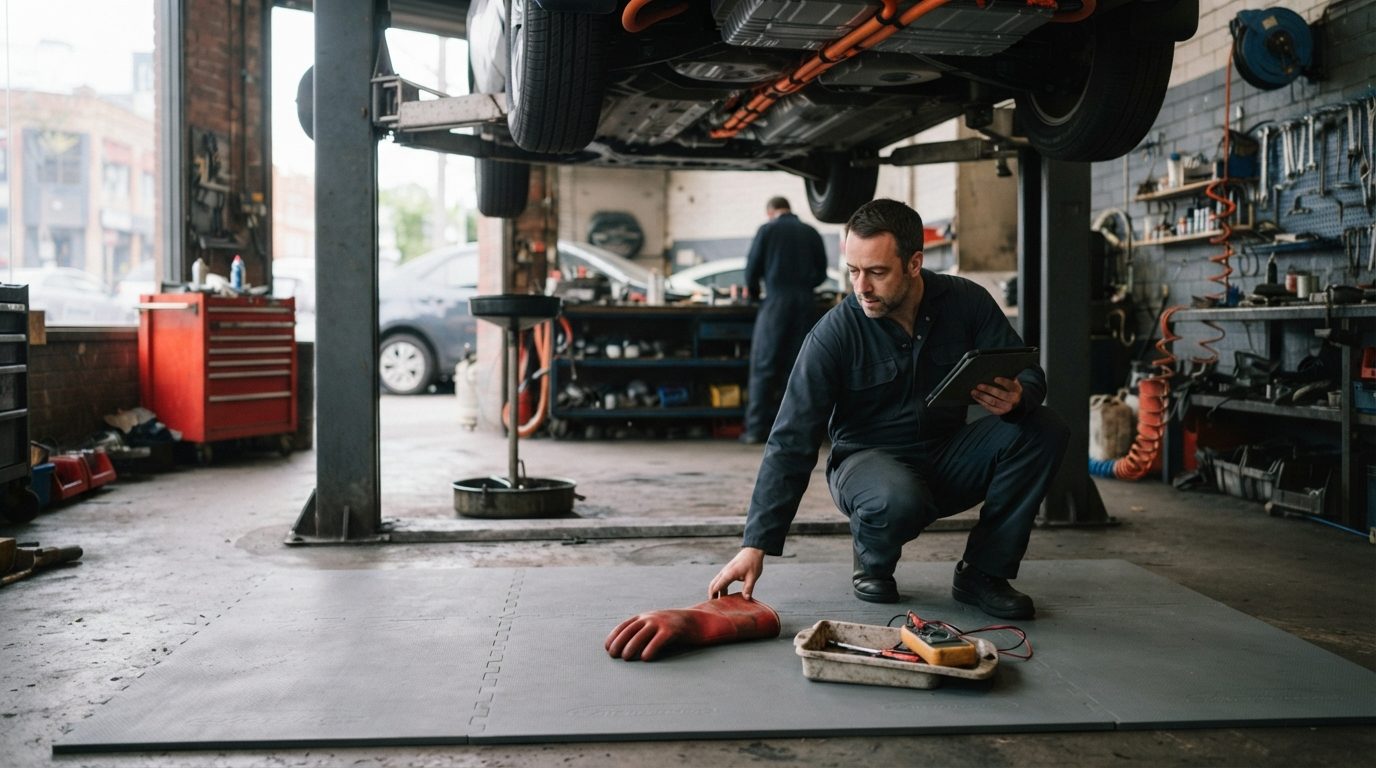
The gate covers the high voltage battery and everything joined to it: the pack, the orange cabling, the inverter, the drive motor and the cooling circuit. Work on any of it needs training, rated equipment and a work area set up for it. The training comes in three steps, and they are not the same thing.
AURETH101 Depower and reinitialise battery electric vehicles. One unit of competency. It covers isolating the high voltage system before work starts and resetting what needs it afterwards. The Australian Automotive Aftermarket Association (AAAA) puts it at 8 to 10 hours.
AURETH102 Inspect and maintain battery electric vehicles, and the diagnose and repair units above it. AURETH101 is its prerequisite, so the units stack.
AUR32721 Certificate III in Automotive Electric Vehicle Technology. A full apprenticeship qualification. Twenty nine units, three years full time.
None of these is a licence. The national training register records no licensing or regulatory requirement against AURETH101. What applies is the standard. AS 5732 covers premises as well as procedures, so gloves rated to 1,000 volts, rated matting and a defined work area matter as much as the certificate. The Certificate III itself notes that licensing requirements vary between states and territories, so check your own regulator before you publish anything.
A certificate is not a licence, and a licence is not what the customer is asking about. They want to know whether their car can safely sit in your bay.
| The job | Can an independent workshop usually do it? | What it takes | What the website has to say |
|---|---|---|---|
| Tyres, wheel alignment, suspension and steering | Yes, with no EV specific credential | Normal workshop capability, plus knowing where the jacking points sit | Name the makes and models you have had on the hoist |
| Brakes, brake fluid, cabin filter, wipers, 12 volt battery | Yes | As above, plus the maker’s service schedule | Say a hybrid or EV service is a booking you take |
| Scheduled logbook servicing on a hybrid or EV | Usually yes | Paid access to the maker’s information, and parts to specification | Say you stamp the book and where the schedule comes from |
| Anything on the high voltage battery, cabling, inverter or drive motor | Only with high voltage training, rated equipment and a set up work area | AURETH101 as the entry unit, gloves rated to 1,000 volts, a defined area under AS 5732 | Name the unit held and who holds it, not the words EV specialists |
| Opening, repairing or replacing a high voltage battery pack | Often no, and that is a normal answer | Maker specific training, tooling, and handling and storage capability | Say who you refer it to. A referral kept beats an enquiry lost |
Yes. Since 1 July 2022 the Motor Vehicle Service and Repair Information Sharing Scheme has required carmakers to sell independent repairers the same service and repair information they give their own dealers, at a fair market price, for vehicles built from 1 January 2002 onwards. The ACCC enforces it. AASRA, the scheme adviser, runs one verification hub for all of them.
The AAAA publishes what it costs. General service and repair information, with verification, is $90 plus GST a year per technician. Safety information for hybrids, electric vehicles, plug-in hybrids and fuel cell vehicles sits behind a separate upgrade: $50 plus GST once off, plus AURETH101 or an equivalent course.
There is a catch worth budgeting for. Some carmakers cannot separate the electric information from the petrol information for the same model, so their whole subscription sits behind the EV certificate. The AAAA raised it in its 2025 submission to the government review: technicians completing the unit only to read about a petrol car.
Fifty dollars and a day of training is what stands between a workshop and the maker’s own instructions. That buys information, not capability, and confusing the two is how a workshop gets into trouble.

The test is whether a customer could check the claim. The words EV specialists cannot be checked. A named unit held by a named technician can.
Name the training and who holds it. “Our technician has completed AURETH101” tells a customer something specific. A badge in the footer does not.
Name the cars you have had on the hoist. Makes and models, not categories. An owner with a Sealion 7 is looking for those two words, not for the word electric.
Name the equipment and show the bay. Rated gloves, matting, the area itself. A photograph of your own workshop does more here than any wording.
Name what you do not do. “We service hybrids and EVs. We do not open battery packs, and here is who we send those to.” That is the line that makes the rest of the page believable.
Watch the wording. A capability claim on a website is a representation like any other under Australian Consumer Law, and the test is what an ordinary customer takes it to mean.
Electric cars are the sharpest current example of an older problem. Capability sits in the workshop and never reaches the website. There is a short way to find the rest.
Pull last month’s invoices and list every type of job on them. Cross each one off against your services page. What is left is work you already do and do not advertise.
What usually survives:
Fleet and small business accounts. Often the steadiest work in the bay, and almost never on the site.
Fixed-price logbook servicing. A defined job at a defined price, and the easiest thing on the list to publish.
Payment terms on major repairs. A $3,000 gearbox is a different conversation if the page says the cost can be spread.
Specific makes and specialisations. European, diesel, four-wheel drive, light commercial. A workshop that services everything says nothing.
When you cannot staff it in a normal week. If one technician holds the high voltage training and takes two weeks off, the page keeps selling work nobody can do. A customer who drives across town on the strength of a page and gets turned away tells more people than one who simply books elsewhere. Publish what the workshop can do on an ordinary Tuesday, not on its best day.
Before a capability goes on the page, answer four questions
1. Who does this work, and what happens the week they are away?
2. Can I show the training, the equipment or the vehicles, or must the customer take my word?
3. What version of this job do I turn down, and does the page say so?
4. If ten of these enquiries arrived next Monday, could I take them?
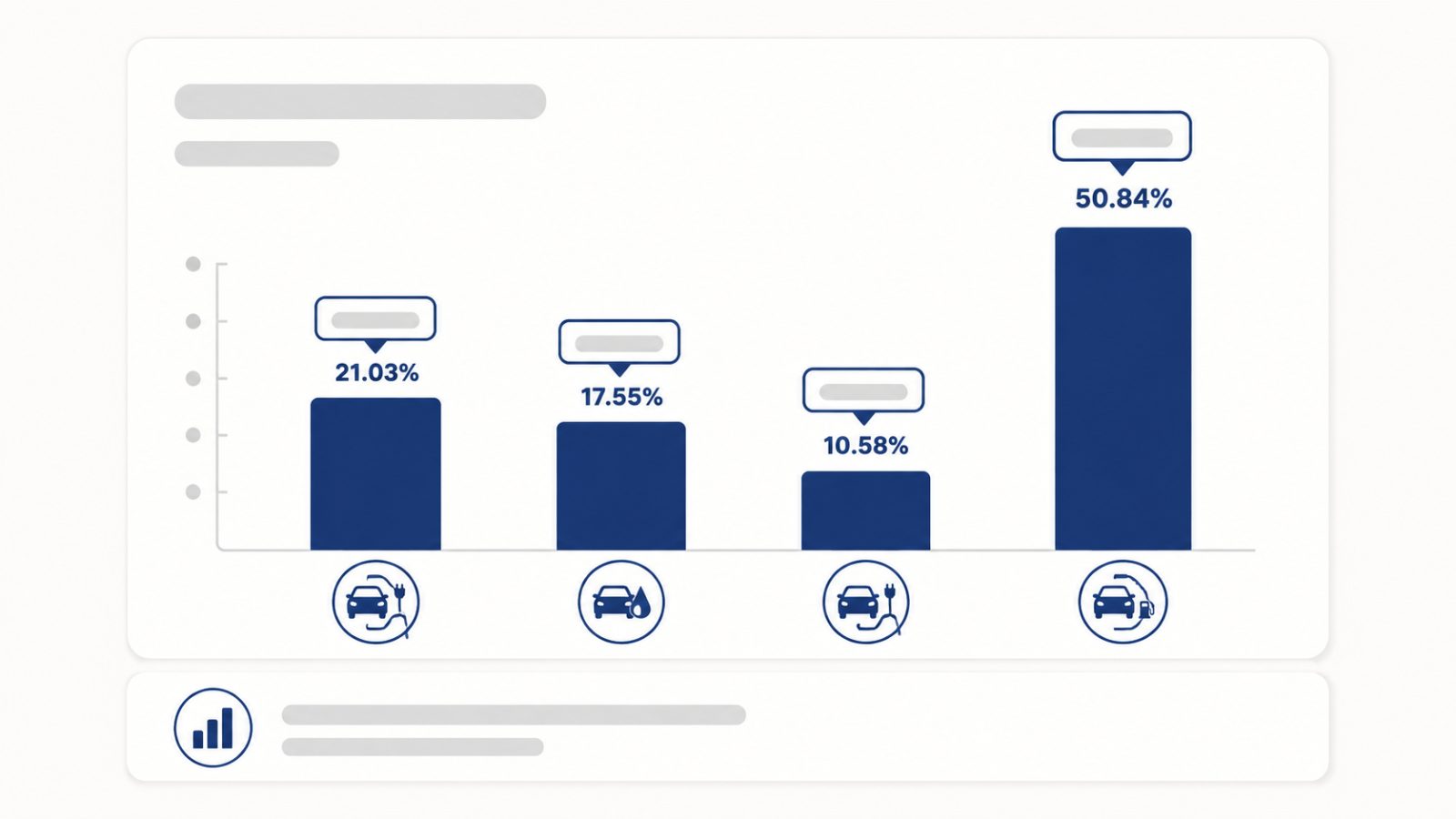
For the quarter to 30 June 2026, the Australian Automobile Association’s EV Index put battery electric, plug-in hybrid and conventional hybrid vehicles at 49.16 per cent of new light vehicle sales. Petrol and diesel took 50.84 per cent, the lowest share the index has recorded. Battery electric vehicles alone reached 21.03 per cent.
Those are new cars. They are under warranty and going back to dealers, and the electrified share of every car on Australian roads is still only a few per cent. That is the point, not the objection. The cars sold this year come off warranty around 2029, and they will go looking for a workshop then.
A workshop that starts saying what it can do in 2029 starts from nothing. One that says it now spends four years collecting what makes the claim believable: the models seen, the units completed, the customers who came back. None of that can be bought later.
If the list from your invoices is longer than your services page, that is a website job, not a workshop job. CJ Digital builds sites for workshops. Send the list through /contact-us/, or start at /website-design-development/, and we will tell you what belongs on it.
Sources checked August 2026: AS 5732:2022 Electric vehicle operations – maintenance and repair; training.gov.au for AURETH101, AURETH102 and AUR32721; the Australian Automotive Aftermarket Association for scheme subscription costs; and the Australian Automobile Association EV Index for the quarter ending 30 June 2026. Training, standards and scheme requirements change. Check the current position before you act on it.
A manufacturer warranty in Australia is generally not voided just because an independent workshop did the servicing, provided the work meets the maker’s specification, with appropriate parts and a qualified repairer. A dealer-sold extended warranty is a separate product and can carry its own conditions. This is general information, not legal advice.
Yes, just less of it. Tyres, brakes, brake fluid, cabin filters, suspension, steering and the 12 volt battery still need attention. What disappears is the engine side: oil, filters, plugs, fuel system, timing belt and exhaust. Australian EV service intervals commonly run to 12 months or 15,000 to 20,000 kilometres, and vary by brand.
No. Opening, repairing or replacing a high voltage battery pack needs specific training, tooling and safe storage, and many makers restrict the work further. Most independent workshops refer it out. Saying so on your website costs nothing and keeps the customer for everything else.
It depends on the job rather than the car. AS 5732 separates routine work that does not involve the high voltage battery from work that does, and a normal service usually falls on the routine side. Some hybrid jobs do call for the system to be isolated first, and the maker’s procedure decides that. Check it before you quote.
The AAAA publishes AASRA subscription costs at $90 plus GST a year per technician for general information, and $50 plus GST once off for the safety information covering hybrids, EVs, plug-in hybrids and fuel cell vehicles. The safety upgrade also requires AURETH101 or an equivalent. Each brand charges separately for its own data portal, at a fair market price.