





At 7.05 pm on Smith Street, two restaurants still have tables free. One Google listing says the kitchen closed an hour ago. The other shows current hours, a booking link, recent dinner photos and reviews that talk about the evening service. Both kitchens are open. Only one of them looks open to a person deciding where to eat. An empty table can start with a local search problem, not a food problem.
Here is the part most owners miss. When someone searches on their phone, Google shows the businesses closest to where they are standing, not the ones sitting inside a particular suburb. Smith Street makes the point better than any map: one side is Fitzroy, the other is Collingwood, and the same search pulls results from both. The businesses that get found work out the streets their customers actually come from, then make their Google Business Profile and website match how people search. That matters far more than stamping your own suburb name across every page.
This is not only an inner-north problem. Any business sitting near a suburb boundary is competing for customers who never think about which side of the line they are on. The inner north just shows it at full volume, because a bar, a design studio and an accountant can share the same block and still need completely different things from local search.
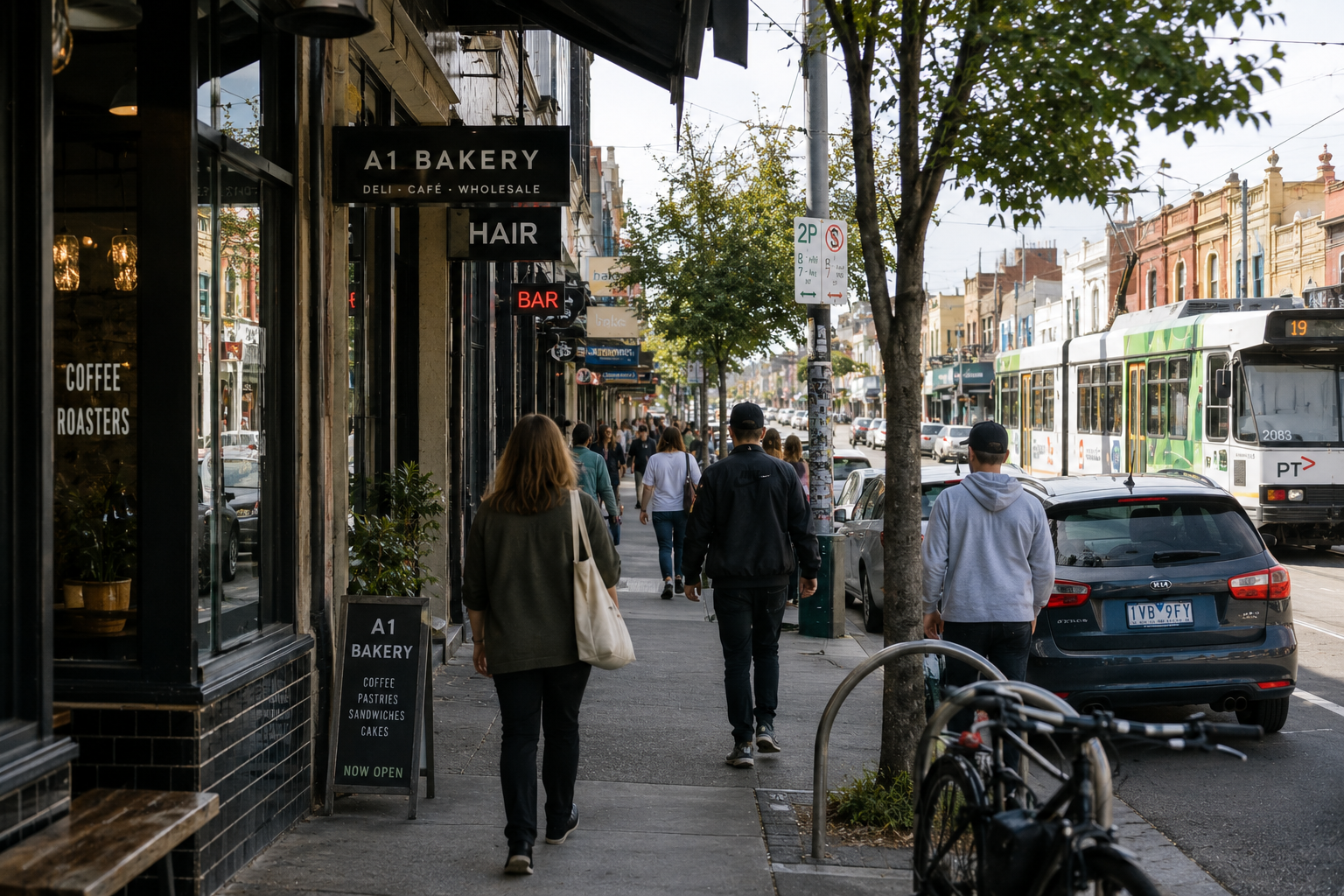
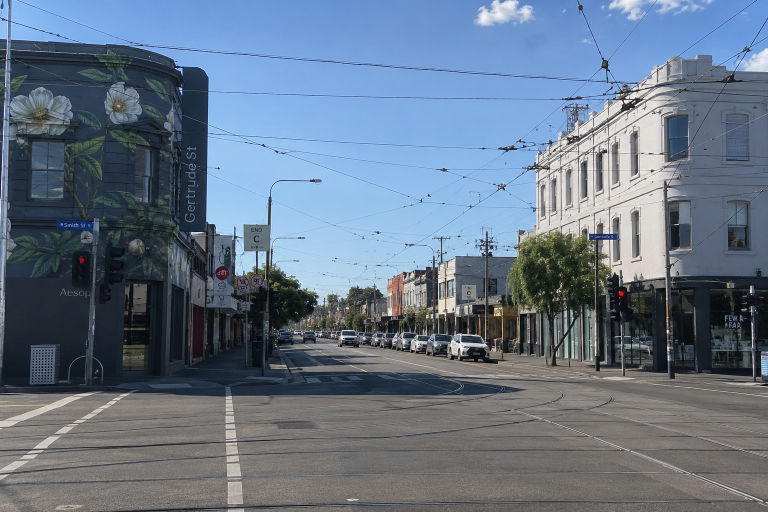
Local customers search by distance and need, not by council boundary. The inner north puts many similar businesses within a short walk or tram ride, which makes that obvious fast. Smith Street runs along the Fitzroy and Collingwood boundary, packed with bars, live music, shops, bakeries and restaurants. Brunswick Street carries fashion, food and nightlife. Gertrude Street adds galleries, boutiques and older pubs. Carlton brings Lygon Street hospitality into the orbit of the CBD and the University of Melbourne. Google is not weighing one business against all of Melbourne. It is sorting a handful of plausible choices inside a very small area.
That density changes what counts as proof. A page that says 'servicing Melbourne' gives Google no reason to connect a business with one strip rather than another. A current menu, the right category, clear access details, real local work and reviews that describe the service make the fit obvious. The job is not to repeat suburb names. It is to remove any doubt about what the business is, where it sits and why it belongs in the result someone is looking at right now.
Local results are shaped mostly by three things: relevance, distance and prominence. Relevance is how closely the profile and website match what someone is looking for. Distance is the physical gap between the business and the search. Prominence is how established the business looks, including links, reviews and other signals across the web.
Only two of those can be improved directly. A business cannot move Smith Street closer to someone standing on Lygon Street, and Google does not sell a better local position. What it can do is pick a specific primary category, keep hours and links correct, and build a steady record of genuine reviews. A restaurant can add menu, ordering and reservation links. A clinic or salon can add services and a booking button. A studio needs the most accurate category for what happens inside it.
The website has to back the profile up. A listing that says 'architect' should lead to services, projects, location and contact details, not a home page full of broad claims. A restaurant profile should not open onto a buried menu or hours that do not match. Reviews can lift prominence, but they cannot fix a wrong category or missing details. The profile and the site need to tell the same story.
Business type sets the main job. The street sets the evidence needed to do it well.
| Business type | Inner-north pressure | What local search rewards | Website and profile priority |
|---|---|---|---|
| Hospitality and retail | Fast decisions, dense competition and details that change often | Accurate category, current hours, recent reviews, menu or product information and fresh photos | Direct booking or ordering, visible opening times, access details and a page that loads quickly on a phone |
| Creative studio or maker | Category ambiguity and a decision based on taste, proof and fit | A precise category, strong project pages, relevant links and clear information about studio access | A useful portfolio, service pages, appointment details and an honest explanation of where work happens |
| Professional service or clinic | A slower trust decision, often involving a named person or specialist service | Detailed service information, clear practitioner or adviser profiles, accurate booking details and credible reviews | Separate service and profile pages, fees or process where suitable, and a simple enquiry or booking path |
The table also shows why a copied formula fails. A Collingwood photographer gains little from restaurant-style posting, and a Carlton adviser does not need a stream of product photos. Each business needs the information that settles its own customer's decision. That is worth far more than adding the same suburb paragraph to every page.
A local page has to earn its place with information. It might cover a real office, distinct local work, access details, nearby projects or conditions that change how the service is delivered. Here is a quick test: it should still help if you removed the suburb name from the heading. The page earns its spot through what it tells people, not through repetition.
Google calls near-identical regional pages that funnel visitors to one place doorway abuse. Ten pages with the same service copy and a different suburb in each title are not a local strategy. They make a bigger site without adding proof. One developed inner-north page can be stronger when the three suburbs are a genuine shared catchment and the business has something real to say about each.
The bar is higher on a street with a strong identity. Gertrude Street is known for food, galleries and boutiques, but it has also been central to Melbourne's Aboriginal community and its social and political life. Using a street like that as a fashionable label, with no useful local information behind it, reads as hollow. A grounded page explains the service, the place, the people involved and the real connection to the area.
Local detail is evidence, not decoration.
Slow pages, blocked indexing and weak site structure are separate ranking problems, and they should be fixed before any new local pages go on.
Most owners can fix the basic local signals themselves, without an agency. Start with the accounts and details you control, then add content only where you have something worth saying. Run this quick local check:
An agency earns its fee when the problem is bigger than missing details: technical faults, several locations, overlapping service pages, poor tracking, or real uncertainty about which services deserve their own page. The value is in joining those parts into one plan, not in producing more copy. A clear monthly report should tie the work back to calls, bookings and enquiries.
A profile can win the click, but the website has to finish the job. Hospitality needs a menu and a booking path that do not take several screens to reach. A studio needs fast project pages that explain the work. A professional service often needs separate adviser, practitioner or service pages, each with a direct enquiry path.
The site also needs a structure Google can read. Important details should sit in normal page text, not only inside images, downloadable menus or social feeds. Pages need descriptive headings, internal links and one clear purpose. The mobile version has to keep the information that matters, rather than hiding it behind design effects. Clear, self-contained pages also give AI answer tools something accurate to quote when they summarise local options.
Design and SEO fail together when the site cannot be updated. Hours change, staff move on, services grow and booking tools get replaced. A site built around rigid layouts turns every small correction into a developer job. Local information only stays useful when the business can keep it current itself.
Local search is not a set-and-forget job, because the streets themselves keep moving. In 2026, Yarra City Council completed a Brunswick Street safety audit with local businesses and Victoria Police. It is weighing future work on lighting, facade upkeep, pedestrian movement near Johnston Street and public seating, with possible capital works in the 2027 financial year. Those plans may change, but they show how access, movement and the look of a street can shift around a business that has been there for years.
When that happens, the website and profile may need new directions, photos, access notes or hours. A business that keeps those details current is easier to trust, and easier to find, than one still describing the street as it was two years ago.
If your profile, website and local pages are pulling in different directions, CJ Digital can review the whole chain. Start with the SEO service page, then send through your current site and the suburbs that bring you real work using the contact form.
Not by default. A separate page is worth it only when Collingwood brings distinct services, projects, access details, staff or customer needs. When the content would be almost identical, one developed inner-north page is usually clearer and carries less risk of turning into a doorway page.
They can help prominence, and Google says more reviews and positive ratings can support local ranking. They are not a guarantee. Accurate categories, distance, complete details and a useful website still matter, and fake or rewarded reviews create policy and trust problems.
More categories are not automatically better. Google recommends using as few as possible and choosing the most specific primary category for what the business is. Extra categories should reflect real parts of the business, not every service or product on the website.
No. Google requires eligible businesses to have face-to-face contact with customers during stated hours. A studio that meets clients in person may qualify, but its address, service area and hours must match how it really works.
It can appear organically across all three when the website has relevant, useful content. Map visibility is more limited, because distance is still part of Google's decision, and no page can remove that physical limit.