




You’re the second generation. The restaurant has been in the family since the late 1980s, the lunch menu hasn’t been updated since 2019, and the booking widget broke two years ago. The website was built by someone whose number nobody has anymore.
That’s a Carlton story more than a Melbourne one. The suburb’s commercial character was set decades ago. A lot of its websites still trade on whatever was built when the original owners’ children finished school. Carlton businesses tend to carry history the website fails to convey, paired with modern customer expectations the website fails to handle.
This article covers what web design for Carlton businesses needs to deliver, focusing on the three groups that dominate the suburb: hospitality, heritage retail, and academic-adjacent professional services.
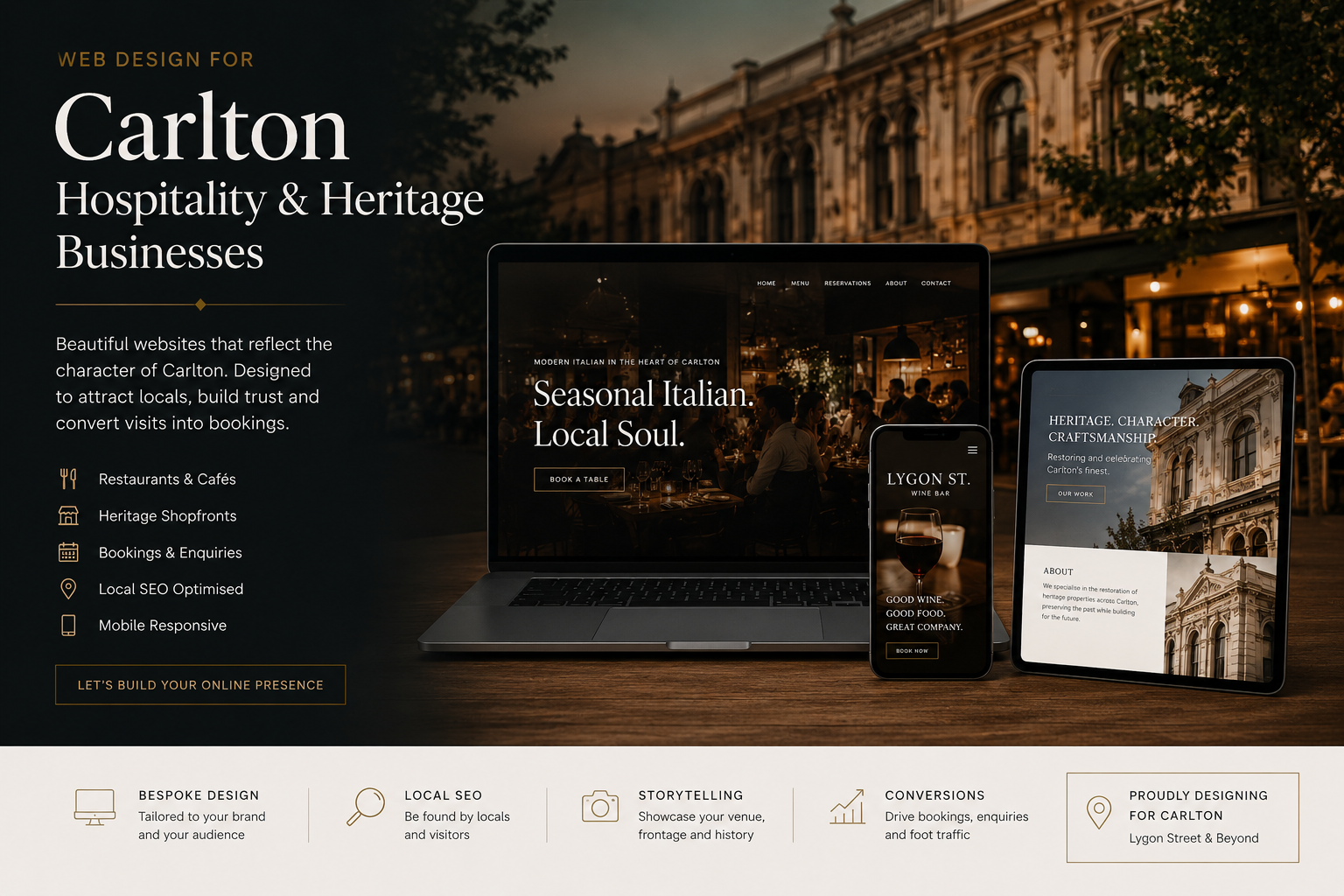
Carlton’s commercial map is unusually concentrated. Hospitality dominates. The rest of the suburb’s businesses cluster more tightly than in suburbs without Lygon Street’s gravity. Four groups carry most of the trade, and each group needs different things from a website.
| Business type | What the website prioritises | Where it commonly fails |
|---|---|---|
| Hospitality | Mobile bookings, current menus, low-light photography, aggregator links | Broken booking widgets, menus 18 months out of date, hero shots that misrepresent the room |
| Heritage retail and culture | Catalogue depth, event programming, newsletter capture | Templated retail themes that flatten curatorial weight |
| Academic-adjacent professional services | Credentialed bios, clear appointments, content the catchment can verify | Heritage exterior undersold by a default template website |
Hospitality is Carlton’s biggest single category by venue count, and the failure modes on hospitality websites are consistent across most of the sites we see.
Heritage retail in Carlton, the bookshops on Lygon and Faraday, the galleries, the specialty shops, has a different brief from hospitality. The catalogue is the substance, not a sidebar.
Carlton’s professional services sit close to the University of Melbourne, the Royal Melbourne Hospital and the Royal Women’s Hospital. That catchment researches before it books.
Two things matter for a practice on Faraday, Drummond or Cardigan Street. First, the audience reads credentials and looks for evidence you’ve worked with people like them. Second, many of these practices operate from converted Victorian terraces, and the contrast between the offline space and a templated website undersells the practice every time. The website is the first impression for an audience that will compare you to two or three other practices before they pick up the phone.
We’ve covered the buyer-behaviour shape of this audience in detail in our piece on building a website for an audience that researches before it calls.
Carlton sits inside the City of Melbourne local government area, and large parts of it, particularly along the Lygon, Drummond and Rathdowne corridors, sit under heritage overlays. Building owners can’t change much about the front of the building. That has direct implications for the website.
AI search and Google’s AI Overviews are increasingly answering “best Italian Lygon Street” and “best Carlton restaurant” queries before the user ever reaches a website. The structural moves that get a Carlton venue cited in those answers are the same moves that have always made hospitality websites work. Depth, schema markup, consistent name-address-phone information, and content that doesn’t drift. We’ve covered the AI search side of this in detail in a separate piece.
For most Carlton hospitality and heritage businesses, the single biggest-impact move on the list above is photography. A professional photography day at the venue’s service times is usually the cheapest move that meaningfully changes how the website performs. Shoot the kitchen working, the dining room at dinner service, the lighting unaltered. Across the Melbourne hospitality websites CJ Digital has built, this is the move owners regret not doing earlier more than any other.
If your Carlton site is sitting on stale photography and a menu that hasn’t moved since 2022, that’s where to start. Get in touch for a heritage-aware website review and we’ll tell you whether a photo day is enough on its own, or whether the rest of the build needs work.
A properly built restaurant website in Melbourne sits in the $8,000 to $25,000 range, depending on booking integration, photography scope and the depth of the menu management. Templated builds run $1,500 to $5,000, but they rarely include the booking, menu and photography needs that a Carlton hospitality venue has. We’ve covered the cost question in more detail in our article on whether a new website is worth the spend.
Yes, almost always. Diners researching where to eat in Carlton scan menus before they read about you. A menu buried in a PDF download or hidden inside an image file gives them friction at the moment of decision. A dedicated menu page, or pages by service, that updates easily is one of the highest-traffic pages on most hospitality sites.
Claim your Google Business Profile. Fill in the primary category accurately (Italian restaurant, modern Australian, cafe and so on). Upload current photos. Keep your hours, phone number and website consistent across the profile and the site. Local pack ranking depends on category accuracy, review volume and recency, and proximity to the searcher. Your website’s structured data and address consistency feed this directly.
For most Carlton venues, a third-party booking platform is the right call. The platforms invest more in the booking experience than any one venue can justify, and they handle table management, waitlists and confirmations automatically. The tradeoff is the per-cover fee and a small loss of customer data ownership. A custom booking flow makes sense only when the venue has unusual booking logic, such as multi-day functions, ticketed events, or membership-only bookings, that a platform doesn’t support.
A standard Carlton hospitality website takes six to twelve weeks from brief to launch. Photography day, copy, design rounds and booking integration are the main schedule drivers. Faster builds are possible if photography is already in place and the menu structure is straightforward. AI-built sites can launch in days but rarely include the depth a Carlton venue’s customers expect.
Most of Carlton sits under City of Melbourne heritage overlays, with specific controls along the Lygon, Drummond and Rathdowne corridors. Signage on heritage frontages typically requires planning approval and faces restrictions on size, materials and lighting. The City of Melbourne’s planning portal is the source of truth: verify with council before committing to a signage scope. The website is where you have the visual freedom the shopfront doesn’t.