




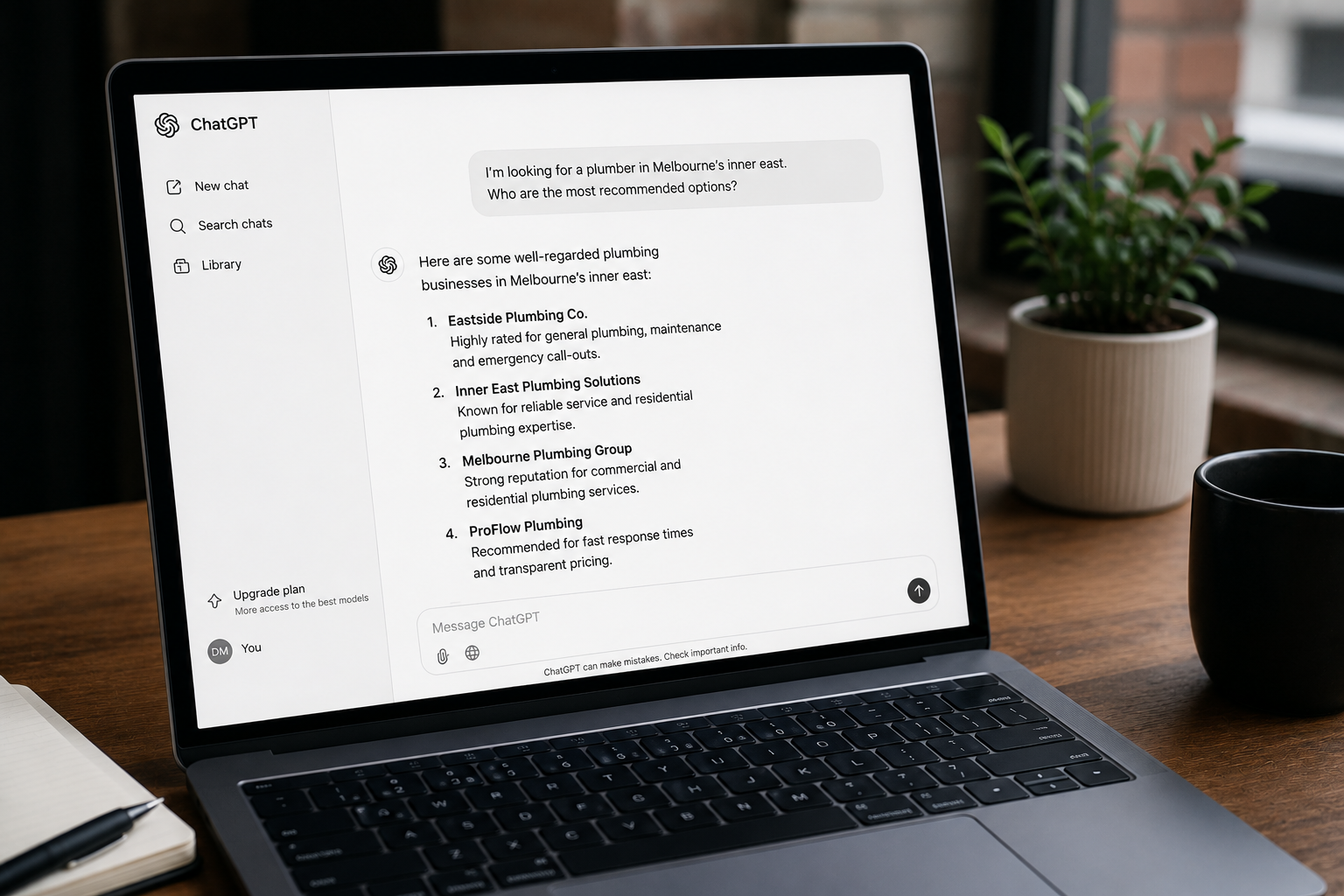
You run a small business in Melbourne. Last week, a potential customer opened ChatGPT and asked, ‘Who is the best plumber in Brunswick?’ or ‘Which web design agency in Hawthorn is good for small businesses?’ The answer named two or three businesses. Yours was not one of them.
That is the new shape of search, and the field that addresses it is called AI SEO. Customers used to type a phrase into Google and scroll. Now they ask ChatGPT, Perplexity, or Google’s AI Overviews a question and read whatever the AI gives back. If your business does not appear in the answer, you do not exist for that buyer.
The work behind AI SEO is concrete. Structured information on your site, third-party signals that confirm you are real, and content that AI engines can extract and quote. This article walks through what is changing, how AI engines decide who to cite, the four foundations to fix first, and how long it takes to start showing up.
Customer behaviour has shifted across four common query types. Each type rewards a different kind of content.
Recommendation and vendor queries reward third-party signals: directory listings, reviews, mentions in industry articles. Comparison and worth-it queries reward your own content. The page that answers the question best gets cited.
AI search engines do not rank ten blue links. They synthesise an answer and pick a small number of sources to ground it. The factors that determine selection are reasonably consistent across studies of ChatGPT, Perplexity, and Google’s AI Overviews.
ChatGPT leans heavily on Wikipedia and Reddit citations for general queries, with industry authority sites filling in for niche topics. ChatGPT also pulls from Bing for live retrieval, which means a Bing Places listing matters more than most Australian businesses realise. Perplexity is more even-handed across primary sources. Google’s AI Overviews still overlap with traditional search results, though the overlap is shrinking as AI Overviews pull from a wider source pool.
The work splits into four practical jobs. The order matters.
Address, team, and structured service pages first. FAQ content second. Third-party signals third. Schema markup helps the AI parse your site, but it is a multiplier on substance, not a substitute for it. CJ Digital’s AI SEO work follows this order across the Melbourne SMBs we work with, because the foundations move the needle before the technical layer makes a measurable difference.
Three approaches that have either stopped working or never did.
A fourth thing also does not work: paying for a ‘ChatGPT placement.’ There is not one. AI engines do not sell positions. Anyone offering to put your business in ChatGPT’s recommendations is selling you something else, usually a directory listing.
Realistic timelines depend on where you start. AI Overviews already appear on the large majority of informational queries, so the citation surface is huge. The question is how quickly your business becomes one of the cited sources.
That is a slower curve than paid ads, but it stacks differently. Each citation makes the next one easier because the AI starts to recognise your business as a known entity rather than re-evaluating it on every query.
Open ChatGPT or Perplexity right now. Ask, ‘Who is the best [your trade] in [your suburb]?’ If your business comes up, you have already done some of this work. If it does not, that is the audit hook to start with. We will publish a detailed walk-through of how to test your visibility across ChatGPT, Perplexity, and AI Overviews in a follow-up article. For now, the test above tells you where you stand on the queries that matter most.
The next twelve months will reshape AI search again. Direct integrations between AI engines and booking systems are coming, which will favour businesses with clean data feeds. Multi-modal queries (a customer photographs a problem and asks the AI what to do) will pull from businesses with strong visual content as well as text. And named-author content, articles with a real human credentialed byline rather than ‘Admin’, is rising in citation weight as AI engines try to filter signal from noise.
If you would like a structured audit of where your business sits in AI search and what to fix first, that is what our AI SEO service covers. We map your current visibility against the queries your customers are asking, identify the gaps, and prioritise the work in the order most likely to move your citation share.
AI SEO is the practice of structuring your business information and website content so AI engines like ChatGPT, Perplexity, and Google’s AI Overviews can find, verify, and cite you when customers ask questions. It overlaps with traditional SEO but adds entity signals, definitional content, and third-party confirmation that AI engines weight more heavily than search engines historically did.
Start with entity signals: a complete Google Business Profile, a Bing Places listing (ChatGPT pulls from Bing for live retrieval), and consistent name, address, and phone number across the major directories. Then publish FAQ content using the actual phrasing your customers use. Then build third-party mentions through industry directories, partnerships, and earned media. Most businesses see their first ChatGPT citations within three months of fixing these foundations.
No. Traditional SEO still matters because AI engines pull from search results, especially Google’s AI Overviews and ChatGPT’s Bing-powered retrieval. AI SEO adds a layer on top: entity clarity, structured definitions, and citation-worthy content. Businesses that abandon Google rankings to chase AI citations usually end up with neither.
Google search returns ten ranked links and lets the user choose. AI search synthesises an answer from a small number of sources and presents the answer directly. The user often does not click through. Visibility shifts from ‘rank in the top three’ to ‘be one of the two or three sources cited.’ The optimisation work is different because the goal is different.
No. ChatGPT, Perplexity, and Google’s AI Overviews do not sell positions. Anyone offering to put your business in ChatGPT’s recommendations is selling something else, usually a directory listing or schema markup work that may or may not move the needle. Paid ads are appearing inside Google’s AI Overviews for some queries, but those are clearly labelled and separate from the cited sources.
Most local businesses see first citations on low-competition queries within three months of fixing entity signals and adding FAQ content. Broader visibility takes six months as third-party signals accumulate. Recommendation-grade authority on core queries takes nine to twelve months for most categories. Faster on niche queries with low competition. Slower on high-competition recommendation queries where established competitors have a citation head start.