
You've read about AI SEO. You know ChatGPT is sending people to local businesses. You've seen the case studies of the Frankston pest controller picking up more leads from AI than from Google Ads. The next question, the one this article answers: is your Melbourne business one of them?
The way to find out is an audit. Not a tool, not a guess. Thirty minutes typing real customer queries into ChatGPT, Perplexity, and Google's AI Overviews and seeing what comes back. Any AI search optimisation Melbourne service starts here. If you don't know your visibility now, you can't measure whether anything you do later is moving it.
Across the 50+ Melbourne SMBs CJ Digital works with, the same pattern keeps showing up. Most owners assume they're either everywhere or nowhere. The truth is messier. Most are cited for branded queries and absent from recommendation queries. That gap is the whole point of running the audit.
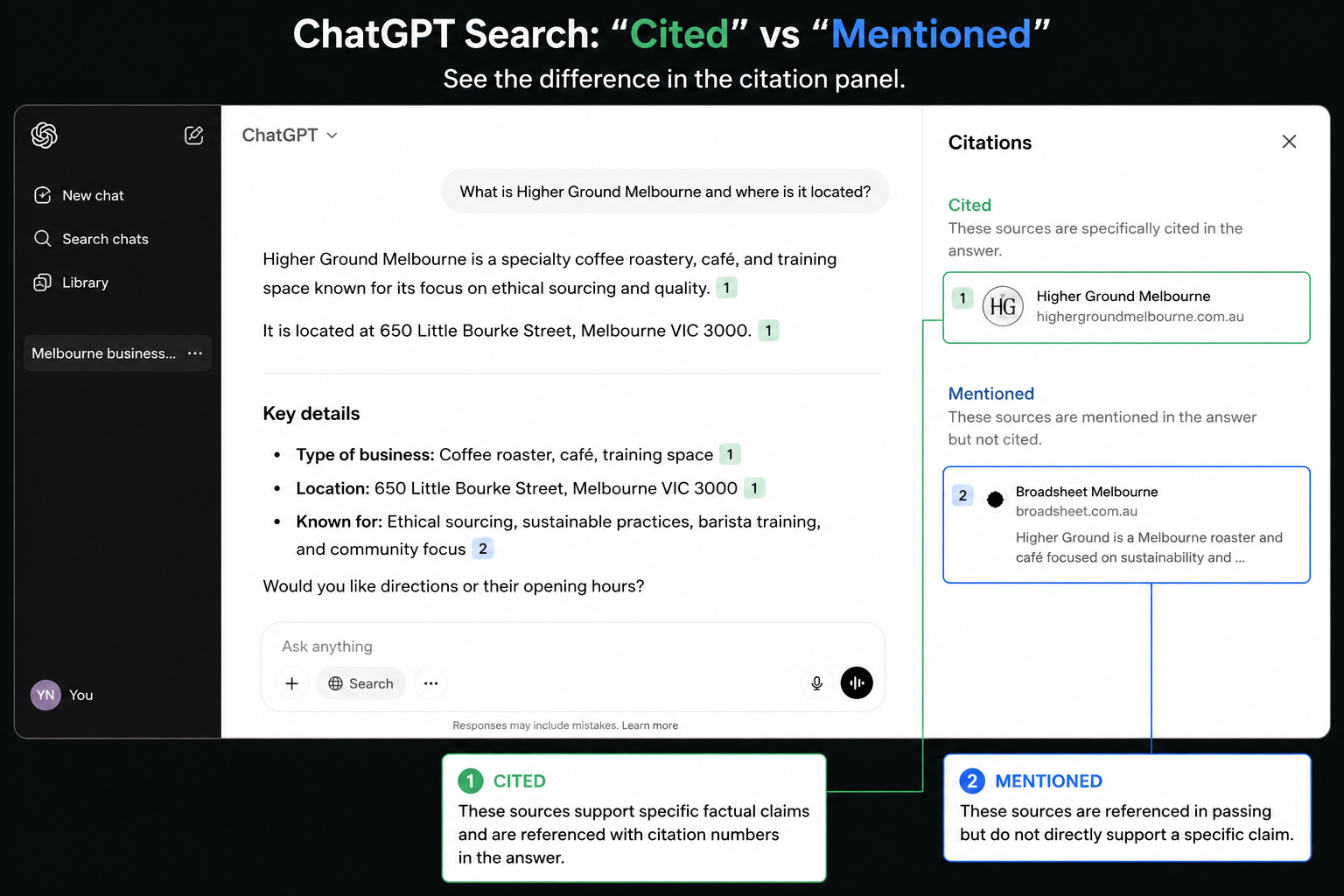
There are three states a business can be in when an AI system answers a query about it. The first is cited: your URL appears as a clickable source link in the answer. The second is mentioned: your business name appears in the answer text without a citation link. The third is absent: neither shows up.
Most Melbourne SMBs running an audit for the first time discover they sit between the second and third states for most queries. They're occasionally mentioned by name for branded searches and absent from the recommendation queries where buying decisions get made. AI search optimisation Melbourne services start by closing that gap between recognition and recommendation.
ChatGPT pulls live information from the Bing index plus its own browsing tools. That has two consequences for the audit. A site missing from Bing's index won't appear in ChatGPT's live answers. A site that ranks well on Bing tends to track well in ChatGPT. The research is consistent: Seer Interactive found 87% of ChatGPT citations align with Bing's top organic results. Bing isn't optional here.
The audit runs on three platforms: ChatGPT, Perplexity, and Google AI Overviews. Open three browser tabs, one for each. You don't need a paid subscription for any of them. The free tier of ChatGPT works fine for this audit because you're testing what an ordinary customer sees.
Type the queries below and record what you find in a simple spreadsheet. Five columns are enough: query, appears (yes or no), cited (yes or no), page cited (the URL), and what to fix.
Test branded queries. Type your business name, your business name plus your main service, and your business name plus your suburb. This confirms ChatGPT recognises you as an entity. If the answer is wrong, sparse, or generic, you have an entity recognition problem before you have a content problem.
Test informational queries that should logically cite you. Type your strongest topic plus "Melbourne" or your service area. If you write extensively about commercial coffee machine repair and a competitor is cited for "how do I diagnose a faulty grouphead," record it. That's a topical authority signal worth tracking.
Cross-check Perplexity and Google AI Overviews. Run the same queries in both. Different platforms, different retrieval logic, different citations. Perplexity tends to show citation links more prominently than ChatGPT. Google's AI Overviews don't trigger on every query. Where they do, they're a useful third datapoint.
Click the citation links. When you appear, the link tells you which page the AI chose. It's often not your home page. The cited page is the one doing the work, and it's the page you treat as your primary asset for that query.
Document the audit. A free Google Sheet works fine. The point is the record, not the format. Without it, you can't compare your visibility three months from now to your visibility today, and the audit becomes a snapshot instead of a baseline.
After 30 minutes you'll have a spreadsheet of 10 to 15 queries with five common patterns. Each pattern points to a different problem and a different first fix. Use the table below as a triage map.
| What you saw | What it means | Where to start |
|---|---|---|
| Cited in branded queries, absent from recommendation queries | ChatGPT recognises you as a business but doesn't see you as a top option in your category. This is a topical authority gap, not a recognition problem. | Build content that answers the specific recommendation queries you tested. The cited page should be your service page, not your homepage. |
| Absent from every query | ChatGPT can't find you. Most often this is a structural content issue rather than a link or domain authority issue. Your content isn't extractable. | Start with a structured FAQ on your most important service page and verify the page is indexed in Bing Webmaster Tools. |
| You appear but the wrong page is cited | Your topical authority is solid, but your on-page extraction signals are pointing AI to the wrong content. | Strengthen the page you want cited with question-form headings, definitional first sentences, and FAQ schema. |
| You appear with outdated information | The page being cited is stale. AI retrieval can lag behind site changes by weeks. | Refresh the cited page. Update statistics, dates, and facts. Republish with a current 'last updated' date. |
| Your competitor appears and you don't | The competitor's content is structured for AI extraction in a way yours isn't. This is a specific structural gap, not a domain authority gap. | Read the cited competitor page and identify the structural differences. Match the structure with your own content and your own information. |
The patterns aren't mutually exclusive. A typical audit surfaces two or three of them at once. Prioritise the row with the highest commercial impact: usually entity recognition first if branded queries are weak, otherwise the absence row covering your highest-value recommendation query.
You can. Several tools run automated checks for free. The two most reputable for a quick one-off audit are Ahrefs' Brand Radar and Semrush's AI Search Visibility Checker. Both query ChatGPT, Gemini, Perplexity and Google's AI Overviews with no sign-up required. You enter your domain and get a report showing total mentions, which platforms cite you, and which competing domains appear alongside your brand.
These tools are useful for a baseline reading. They are not a substitute for the manual audit if you run a local Melbourne business.
Free tools generate their queries from broad search behaviour. They will check whether ChatGPT mentions you for high-volume queries like "best [your category]" or "top [service] companies". They will not check the specific recommendation queries your customers type, such as "best conveyancer in Pakenham". Those are the queries that produce leads, and those are the ones you need to run yourself.
Use a free tool for a baseline. Then run the manual audit on the queries that match how your customers search. The two together take less than an hour.
Audits surface a list of fixes. Working through them in random order wastes time. The order matters because some fixes unlock others.
The four foundations Topic 4 covered (the four foundations of AI SEO) are the structural part. The audit tells you which foundation to work on first; the foundations themselves are the same.
Quarterly is the right cadence for most Melbourne SMBs. Four audits a year, each taking 30 minutes, give you a longitudinal view of whether visibility is moving and in which direction. More frequent and you're watching weather rather than climate. Less frequent and competitor movement gets two quarters ahead of you before you notice.
Two situations warrant an unscheduled audit. The first is after any major site change: a rebuild, a domain migration, a content overhaul, a CMS swap. AI search retrieval can lag behind these changes by weeks. Audit before the change to capture your baseline; audit again 30 days after to confirm nothing critical has dropped out of the index. The second is before you renew an AI SEO retainer. The audit is the simplest measure of whether the work is producing visibility, and the conversation with your agency is sharper when you arrive with data.
You check by typing the queries your customers would use into ChatGPT and seeing whether your business appears in the response or its citations. Look for three states: cited (your URL appears as a source link), mentioned (your name appears in the answer text), and absent (neither). Run at least 10 queries across recommendation, branded, and informational categories. Document the results in a simple table so you can compare across quarters.
ChatGPT doesn't mention a business when it can't find clear evidence of that business as the answer to the query. The cause is usually one of three things. Weak entity recognition means your business isn't established as a known organisation in the AI's source data. Weak topical authority means your content doesn't strongly match the query. Weak indexing means your site isn't in Bing's index, which ChatGPT relies on for live retrieval.
Quarterly is the right cadence for most small businesses. Four audits a year give you a clear view of whether your AI visibility is moving and in which direction. Run an additional audit after any major site change, including a rebuild, migration, or content overhaul. Run one more before you renew an AI SEO retainer. Document each audit in the same format so the data is comparable across quarters.
No. ChatGPT does not sell placements in its answers, and there are no advertising slots in its response text or citations. Anyone offering paid AI mentions is either misrepresenting traditional SEO work or using techniques that violate the platform's terms. Visibility comes from being the right answer to the query, not from paying to appear.
It means your competitor's content is structured for AI extraction in a way yours isn't. Your competitor is usually winning on one of three factors. Question-form headings that match the search query language. Definitional first sentences that give the AI a clean extractable answer. Stronger entity signals through external mentions and structured data. Read the cited competitor page as a free intelligence brief on what the AI is rewarding for that query.
Run an audit before deciding. Strong Google rankings often correlate with AI citations because most AI systems retrieve from indexed pages. The correlation isn't perfect. Pages that rank well on Google sometimes don't appear in ChatGPT because they aren't indexed in Bing or because their on-page structure doesn't extract cleanly. Audit first, then decide whether the correlation is holding for your site.
There's one finding the audit reveals but doesn't solve. When ChatGPT cites you with information that isn't right, the visibility problem isn't absence. It's misrepresentation. The cited page may show the wrong service area, an outdated price, or a former staff member. It may carry a fact about your business that was true two years ago but isn't now.
Misrepresentation is harder to fix than absence. Absence has clear next steps: structure the page, index in Bing, build the content. Misrepresentation needs you to find the cached or stale source the AI is pulling from, update it, and wait for the AI's index to refresh. That can take several weeks even when you push a clean signal.
Treat absence and misrepresentation as different problems with different fixes. The audit's job is to surface both. Both are within reach. Neither resolves itself.
If your audit surfaces problems you'd rather hand to someone else, our AI search optimisation Melbourne services are built around the work this article describes. We run the audit, document the gaps, and fix the structural issues that move you from absent or misrepresented to consistently cited.