





CHRISTMAS HOLIDAY

Our office is going to take a short break at Christmas.

OFFICE CLOSED FROM: 19th Dec '25 - RE-OPENS: 5th Jan '26

♥ CJ DIGITAL

Why replying too fast makes a bad Google review worse

The one-star review lands while you're between meetings. You read it. You read it again. You feel sick, then angry. The urge to reply inside the next ten minutes is strong, and that urge is where the damage gets done. 

We handle reputation management work for Melbourne clients at CJ Digital, and we see the same pattern on repeat. The review is bad. The reply, written in the wrong frame of mind, is worse. It goes up without being read by anyone else. The customer responds. Other customers read the exchange and leave with a worse opinion of the business than the review alone would have given them. The review has now done more damage than it ever could have on its own. 

This article is about process. A separate CJ Digital post covers reply wording, and we link to it at the end. The focus here is the discipline before the keyboard: who decides, what you check, who signs off, and whether to reply at all.

The 24-hour rule

Default position: wait 24 hours before you reply to a bad Google review. The review is not going anywhere in that time. Your emotional reaction is. A reply posted inside the first hour is where regret lands. It is also the reply the reviewer is most likely to fire back at. 

Twenty-four hours gives you time to: 

  • Calm down enough to read the review without a defensive filter 
  • Check internal records and work out what happened 
  • Loop in anyone else who needs to be involved 
  • Get at least one other person to read the reply before it goes up 

There are three narrow situations where the 24-hour rule does not hold: 

  • A specific factual error the reviewer would want corrected. If the review names the wrong business, wrong staff member, or wrong date of service, a short factual correction posted quickly is reasonable. Stick to the facts. Do not argue the substance of the review. 
  • A safety issue that needs public acknowledgement. If the review raises a concern about safety or wellbeing, silence for 24 hours reads as indifference. A short acknowledgement is appropriate, not a defence. 
  • A review that is clearly not from a real customer. This does not get a reply. It gets flagged through Google's review removal process. Replying to a fake review legitimises it. 

If the review does not fit one of those three, wait the 24 hours. 

Fact-finding before the reply

Before anyone drafts a reply, someone needs to work out what the review describes. This is administrative work and it happens offline. Records first, drafting second. 

The questions to answer: 

  • Who is the customer? Match the review against your booking, enquiry, invoice or CRM records. The reviewer may use a different name to their booking, so search by date, service, or staff member involved if the name does not match. 
  • What happened? Pull the emails, file notes, or transaction history. Walk through the sequence from first contact to the end. Do not rely on memory, especially if the interaction was more than a week ago. 
  • Is the complaint fair? A review can be emotionally worded and still contain a legitimate complaint. Separate the tone from the substance. Note any point that is accurate, even partially. 
  • Are there factual errors in the review? Note them, but do not plan to correct them in public. A factual error in a review is usually better left alone than chased through a Google reply. 
  • Was the reviewer a customer at all? Some reviews come from competitors, disgruntled ex-staff, or mistaken identity. If you cannot find any record of the person, flag the review through Google before you consider replying. 

If you cannot answer those five questions, you are not ready to reply. A reply posted before the fact-finding is done is a defence against something the business does not yet understand. 

Who reads the reply before it goes live

A public reply to a bad review is a business decision that needs the usual business sign-off. Three people should be involved before a reply is posted: 

  • The business owner or a co-decision-maker. Someone with the authority to commit the business to what the reply says. If the business has multiple owners or partners, all of them need sign-off, or there needs to be an agreed protocol for who signs off in a review situation. 
  • The staff member involved, if named or implied. They have information nobody else has. They also have a right to know what the business is saying about an interaction they were part of. 
  • A lawyer or your insurance-backed legal helpline, if the situation has crossed into legal territory. Content in a reply can cross into defamation, breach of confidentiality, or Australian Consumer Law territory faster than people realise. A short call before posting can prevent a reply that creates more exposure than the review. 

What goes wrong when this does not happen: the person who read the review first writes the reply, posts it, and tells the rest of the business afterwards. The sequence is backwards. A public reply the business cannot defend is harder to walk back than a review nobody replied to. 

Write the angry version, then throw it away

Writing the angry version is a release, not a draft. Write the reply you would post if there were no consequences. Get everything off your chest. Name the reviewer, call out the inaccuracies, defend the staff, point out what the customer did wrong. Put it in a document, not in the Google reply field. 

Then delete it. 

The reply you will post is a separate piece of writing. It is short, professional, and does not engage with the substance of the review. Its job is to show other readers that your business handles complaints well. It is written for the audience of prospective customers who will read this exchange over the next 12 months, not for the reviewer. 

The separation matters. The angry draft is for you. The reply is for the people watching.
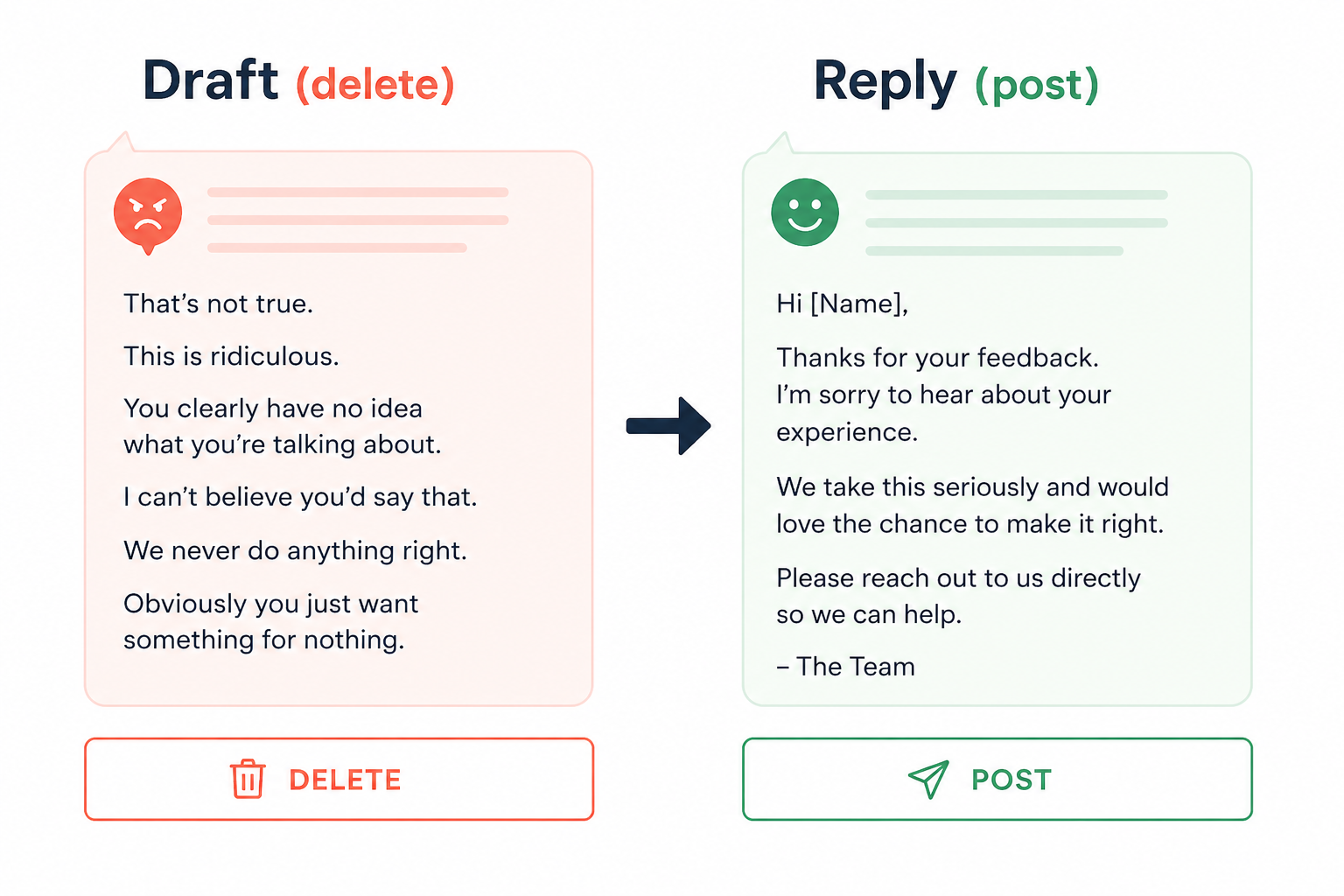
Write the angry version simple two-column visual, Draft (delete) and Reply (post)

The sober set of eyes

Before the reply goes live, someone who was not involved in the original situation reads it. They are not there to redraft it. Their job is to catch: 

  • Grammar and spelling errors that will undermine the reply 
  • Anything that reads as defensive, sarcastic, or personal 
  • Identifying information about the customer that should not be in a public reply 
  • Anything that contradicts what the business has said elsewhere on the website, in other replies, or in marketing 
  • Anything that could be read as admitting legal liability 

The test: if a prospective customer saw only this reply, would they still consider your business? If the answer is no, the reply needs more work. 


When to reply publicly, and when to take it offline

The decision to reply publicly at all is bigger than the wording. Some situations are better handled offline. Others need a public reply so other readers see the response. Some need both. 

Situation  Reply publicly?  Take offline? 
The review is accurate and reflects a real service failure  Short acknowledgement, no excuses  Yes. Offer to discuss directly with the customer 
The review contains factual errors  Correct the facts briefly, no argument on the substance  Yes, if the customer is reachable 
The review describes a confidential matter (medical, legal, financial detail)  Brief non-specific response only  Yes. All substance handled privately 
The review is from someone who is not a customer  No reply. Flag for removal  N/A 
The review is clearly malicious (ex-employee, competitor, personal grudge)  No reply. Flag for removal and document  N/A 
The review is about a staff member's conduct  Short reply acknowledging the concern  Yes. Internal process handled offline 

When a public reply does go up, it sits next to the review permanently. Other customers read both. A reply written as a reflex is the evidence potential customers use to decide whether to bring their business to you. 

Warning signs the process has failed

If any of the following is true when you are about to post a reply, stop: 

  • You are writing at night. Judgement at 9pm is worse than judgement at 9am. Almost nothing about the situation is improved by publishing tonight. 
  • You are writing alone. The reply has not been seen by a business partner, manager, or second pair of eyes. 
  • You are writing angry. The emotional response is still running. You will regret the tone tomorrow. 
  • You are writing within an hour of reading the review. Not enough time has passed for the fact-finding to happen properly. 
  • You are replying from a personal account or device. The reply should come from the business's Google account, with whatever governance the business has around that account. 

Any one of these is a reason to stop. Two or more is a reason to have somebody take your phone. 

What the process protects you from

Discipline before the reply protects against a short list of recurring problems: 

  • Reactions the business cannot delete cleanly. Google Business Profile replies can be edited or deleted by the business, but the original version is often screenshotted or quoted by the reviewer before any edit. What goes up lives somewhere. 
  • Legal exposure in both directions. Reviewers sometimes cross into defamation territory, and businesses sometimes cross into it in reply. Under Australian defamation law, corporations with fewer than 10 employees can sue for defamation, and the reformed laws in New South Wales, Victoria, the ACT and Queensland require a plaintiff to prove the publication caused or is likely to cause serious harm. Section 18 of the Australian Consumer Law bans misleading or deceptive conduct in trade or commerce, which applies to things like publishing fake reviews, hiding genuine negative feedback, or lying about who a reviewer is in a reply. If the situation feels legal, ask a lawyer before posting. 
  • Damage to other customers' trust in how you handle problems. A bad reply changes what prospective customers think about how the business handles a complaint. Reputation management on Google Business Profile is rarely about the star rating. It is about the pattern of replies showing under the stars. 
  • The escalation trap. A reviewer who gets a defensive, accusatory, or dismissive reply often replies back. The second version is usually longer, sharper, and harder to ignore than the first. They may edit the original review to amplify the complaint, post more reviews under different names, screenshot the exchange and share it on social platforms, or forward it to a journalist if the business has any public profile. Legal threats to a reviewer, credible or not, trigger the same pattern from the other direction. Either way, the business's response to a public complaint becomes a bigger story than the complaint itself. The worst version of this sequence is the one where the reviewer was going to let it go after posting, and the reply is what brings them back. 

The discipline's real value is in keeping the review contained.
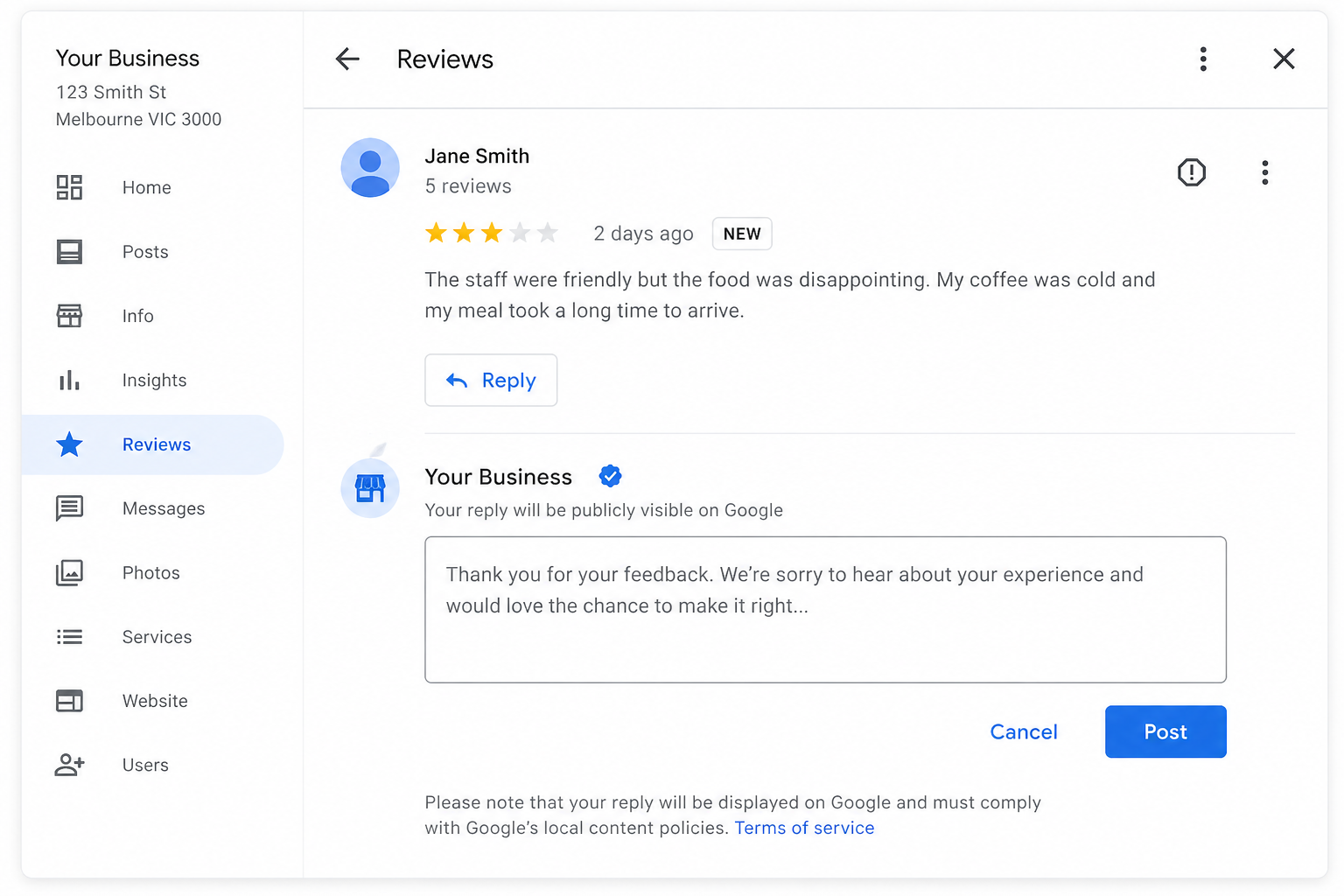
The Google Business Profile reply interface for a business owner responding to a review.

The step most businesses miss

Before any of this process can run, the business has to know the review exists. Small businesses often find out about bad reviews days or weeks after they were posted, because the owner does not have notifications enabled, the Google Business Profile is managed by a former employee, or nobody knows whose phone the alerts go to. The discipline in this article assumes the business is aware of the review in the first place. 

If you are not sure who monitors your reviews, who has access to reply, or what your escalation protocol is when a bad one lands, fix that before you need it. A documented protocol, a monitoring tool that alerts the right person, and a short checklist of the steps in this article is cheap preparation. It is also what stops the 9pm reply from ever being drafted. 

We handle online reputation management for Melbourne businesses at CJ Digital. If you have a review situation you are not sure how to handle, or you want a protocol set up before you need one, get in touch. If you are looking for wording guidance for a reply, our earlier post on responding to Google Business Profile reviews covers that ground.


Copyright CJ DIGITAL 2026 | All Rights Reserved