




Web design in Melbourne starts at around $3,000 and runs past $50,000 for some projects. That gap isn't because agencies price the same work differently. It's because what gets called 'a website' covers very different things at different price points. The harder question for a small business owner isn't which agency to pick. It's which tier of work actually matches the business they're running.
What follows is a plain-language map of the three tiers, what drives the gap between them, and how to tell which tier matches your stage as a Melbourne business owner.
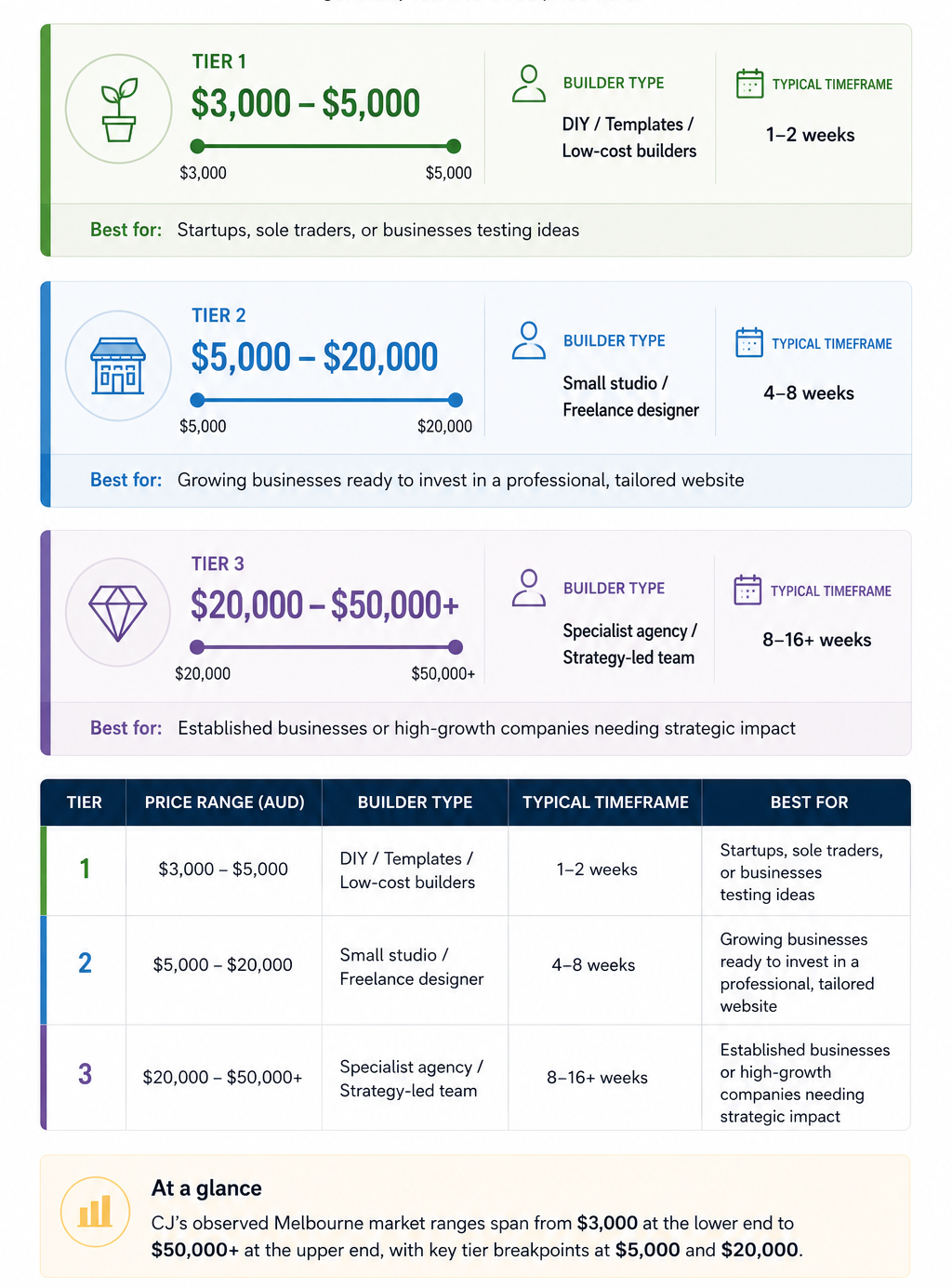
The price points of sites built in Melbourne often cluster into three tiers. Each tier means different work, by different people, on different platforms, with a different relationship between agency and business after launch.
| Tier | Price range | Typical builder | Build approach | Timeframe |
|---|---|---|---|---|
| Entry | Under $3,000 | Solo template assembler or freelancer sometimes working with a designer | Template configured around your content, or simple design refresh | 2 to 4 weeks |
| Mid | $3,000 to $10,000 | Small agency or established studio | WordPress with a professional page builder or custom build | 8 to 12 weeks |
| Premium | $10,000 and up | Multi-discipline team | Custom design and development, Webflow custom builds or deep integrations | 12 to 20+ weeks |
Five things genuinely change between tiers. Most quote variations trace back to one or more of these.
In our 12+ years of watching small businesses move between tiers, many web projects fall into the following groups.
Entry tier (under $3,000). You're buying someone's time to configure a template and apply your content. The designer's value is speed and basic competence. The site works. It looks tidy. It may not stand out significantly from competitors because it is using the same template stack, and the design choices will reflect the template's defaults more than your business's positioning.
Mid-tier ($3,000 to $10,000). You're buying a strategically built website. Someone has thought about who buys from you, how they decide, and what the site needs to do at each stage. The design is custom within a sensible framework. The build is on a platform you can edit yourself after handover, and you own the assets. The project typically runs 6 to 12 weeks from kickoff to launch, with a real settling-in period afterward.
Premium ($10,000 and up). You're buying an ongoing partnership with a multi-discipline team. The site is one deliverable inside a longer strategic engagement that usually covers brand, content, analytics, and integration with other business systems. For most small businesses, premium is the wrong fit. Not because the work isn't good, but because the support model assumes a marketing operation already exists to plug into. Premium fits businesses already running meaningful marketing budget and the internal capacity to use what gets built.
Every tier has a failure mode. Knowing them protects you.
This is one place CJ's own approach diverges from the entry-tier norm. CJ's builds operate with no lock-in contracts, on platforms the client owns outright after handover. It's not a feature you should have to ask about. It's the baseline you should expect.
The build promises conversion improvements that the underlying offer can't deliver. A better website helps a strong offer reach more customers. It does not fix a weak offer. If conversion is the brief and the offer hasn't been tested, the project is solving the wrong problem.
A rough framework. Four variables matter more than anything else.
Two composite Melbourne scenarios show how the variables stack up.
A Brunswick destination retailer turning over around $40,000 per month, with $1,500 per month going into local social ads and search, owner-operator handling marketing personally. Mid-tier is the natural fit. Entry-tier work won't differentiate them from competing retailers a block away. Premium spends budget that should be going into stock and inventory.
A Hawthorn professional services firm turning over $250,000 per month, with a full-time marketing coordinator and $8,000 per month in paid search and content. Premium fits. The team can absorb strategic outputs, customer expectation justifies the spend, and the website is one part of a marketing operation already running.
Most websites built between 2019 and 2021 are aging out. Page speed expectations have moved. Mobile traffic now sits above 70% of visits for most local businesses, and sites designed mobile-second don't hold up. AI search is changing what gets retrieved and cited, and content architecture matters in ways it didn't five years ago.
The rebuild market is putting pressure on mid-tier pricing. Agencies that built a lot of sites in 2019 to 2021 are seeing the same clients come back for a rebuild, and the cost calculation has shifted. A site that cost $8,000 to build five years ago might cost $12,000 to rebuild today, partly because AI-ready architecture, schema, and structured content are now baseline expectations rather than premium add-ons.
One specific signal worth knowing: if your quote sits at the top of one tier and the bottom of the one above, you're probably looking at a brief that's in the wrong tier for your stage. Either the build is over-scoped for what your business needs, or it's under-scoped and the agency is straining to fit. The brief is worth a second look before you compare quotes.
Knowing the tiers is the work. Picking the best web designer in Melbourne is the easier part once the tier's clear.
CJ Digital has built websites for Melbourne small businesses for over twelve years. Most of our work sits in the mid-tier: small business websites on WordPress with a strong page builder, designed around how the business sells, built in Melbourne, and handed over with no lock-in contracts. If you're trying to work out which tier suits your business and want to talk it through, get in touch.