


SEO is one of the strongest marketing investments a small Melbourne business can make. It is also one of the worst-fitting ones, depending on where the business is right now.
At CJ Digital, our SEO services in Melbourne are built for businesses that are ready for them. Across 12+ years working with small business owners across the city, we have found ourselves talking people out of an SEO program at least as often as we have recommended one. This article walks through the four scenarios where SEO is the wrong call, what to invest in instead, and the point at which the calculation flips.
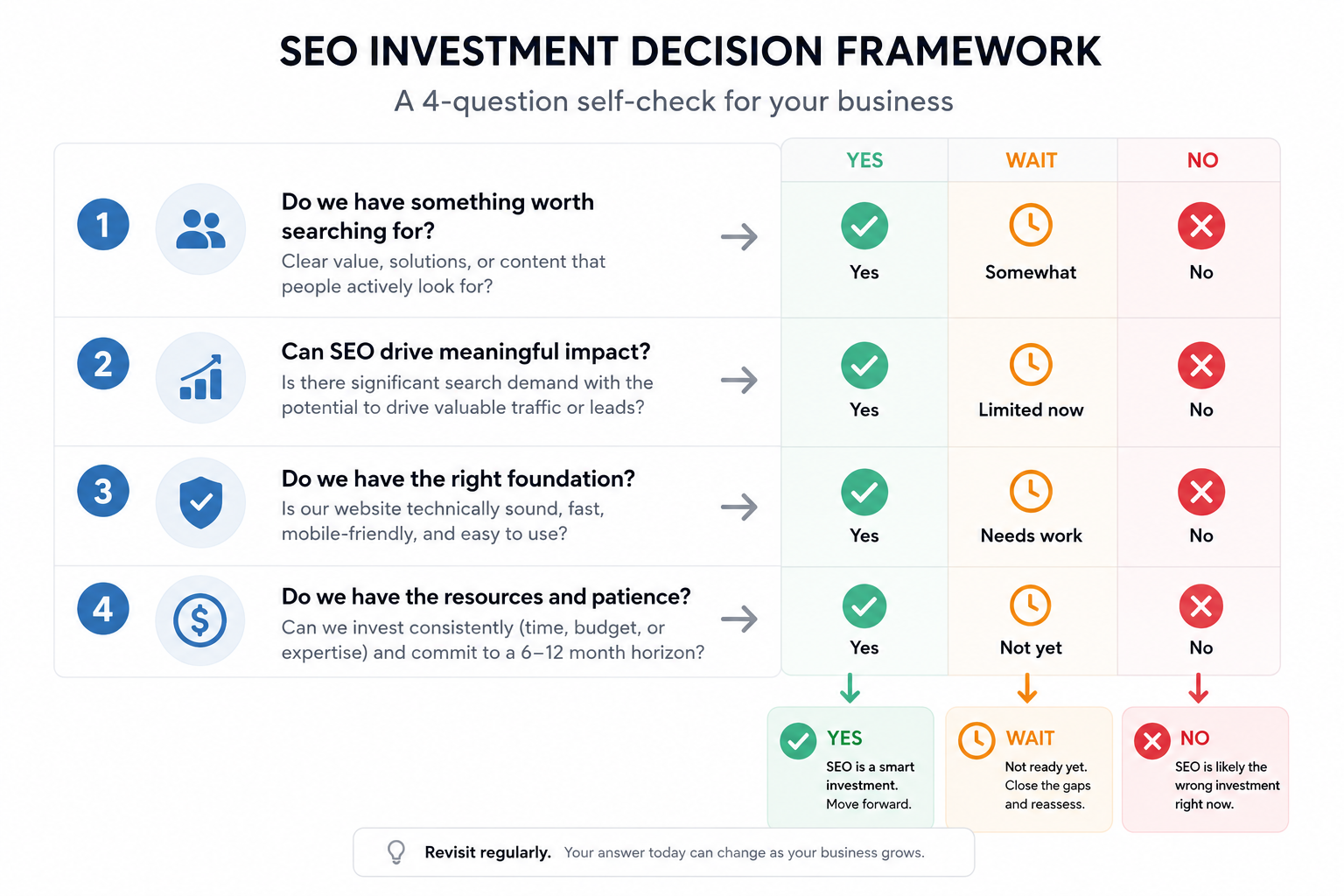
Four things need to be true before an SEO program is the right marketing move for a small business:
When all four are true, SEO is usually the highest-ROI move in a small business marketing mix. When any one is missing, the calculation changes.

These four situations come up regularly in conversations with Melbourne small business owners. If your business looks like one of them, SEO is probably not where your next marketing dollar should go.
This catches a lot of newer businesses. You have launched, you have customers, but you are still refining your offer. Maybe you are testing whether to focus on residential or commercial work. Maybe your service packages are about to change. Maybe you are considering a price reset.
Building SEO authority for a service description that is about to change is wasted spend. The pages, the keywords, the internal links and the content schedule all assume your offer is settled. If it is not, you are investing in foundations for a building you are still designing.
The cleaner approach for businesses in this phase: prove the offer first, then invest in long-term visibility for the version of the business you have actually committed to.
A corner cafe in Hawthorn. A florist in Fitzroy. A barber in Northcote. These businesses get most of their discovery through Google Business Profile, foot traffic and word of mouth. A customer searching for a cafe nearby sees the map pack first, the reviews, the photos, the opening hours. They rarely scroll past the map to read a blog post.
For these businesses, the website's job is to support the Google Business Profile, not compete for organic SEO traffic the business does not really need. The investment that moves the needle is GBP optimisation, photo quality, review collection and post consistency, not 24 articles a year on long-tail keywords.
Some businesses sell to twenty or thirty named companies. They know who they all are. The buyers at those companies know who they are. Nobody discovers them through Google because the discovery happened five years ago at an industry event or through a personal referral.
Building SEO authority to be found by strangers is not the highest-ROI move for a business like this. Direct outreach, partnership content with complementary providers, account-based marketing and a strong LinkedIn presence usually pay back faster. The total addressable market is small enough that mass visibility is not the constraint on growth.
SEO is a content game. You can rank for a handful of low-competition local terms with a well-built website and good Google Business Profile work, but anything beyond that needs publishing. Articles, guides, case studies, comparison pages, FAQs.
If publishing is not going to happen, neither will the ranking gains. There is no point paying for an SEO program whose primary deliverable you will not agree to make. SEO without content is the most common reason SEO investments disappoint.
In our 12+ years of watching small businesses move between tiers, many web projects fall into the following groups.
If you have recognised your business in one of the scenarios above, here is the better-fit alternative for each:
The calculation flips at a specific stage. The four preconditions all line up:
When all four are true, SEO is usually the move. The compounding nature of organic visibility means a Melbourne small business that invests properly for two or three years usually ends up with a lead source that costs less per acquisition than any paid channel, and one that is harder for competitors to dislodge.
This is the stage most of our SEO services are designed for. A business with a stable offer, a sensible time horizon, and a real willingness to invest in content alongside the technical and link work. We do not lock anyone into long-term contracts because we do not need to. When the readiness is there, SEO works. When it is not, no contract is going to fix that.
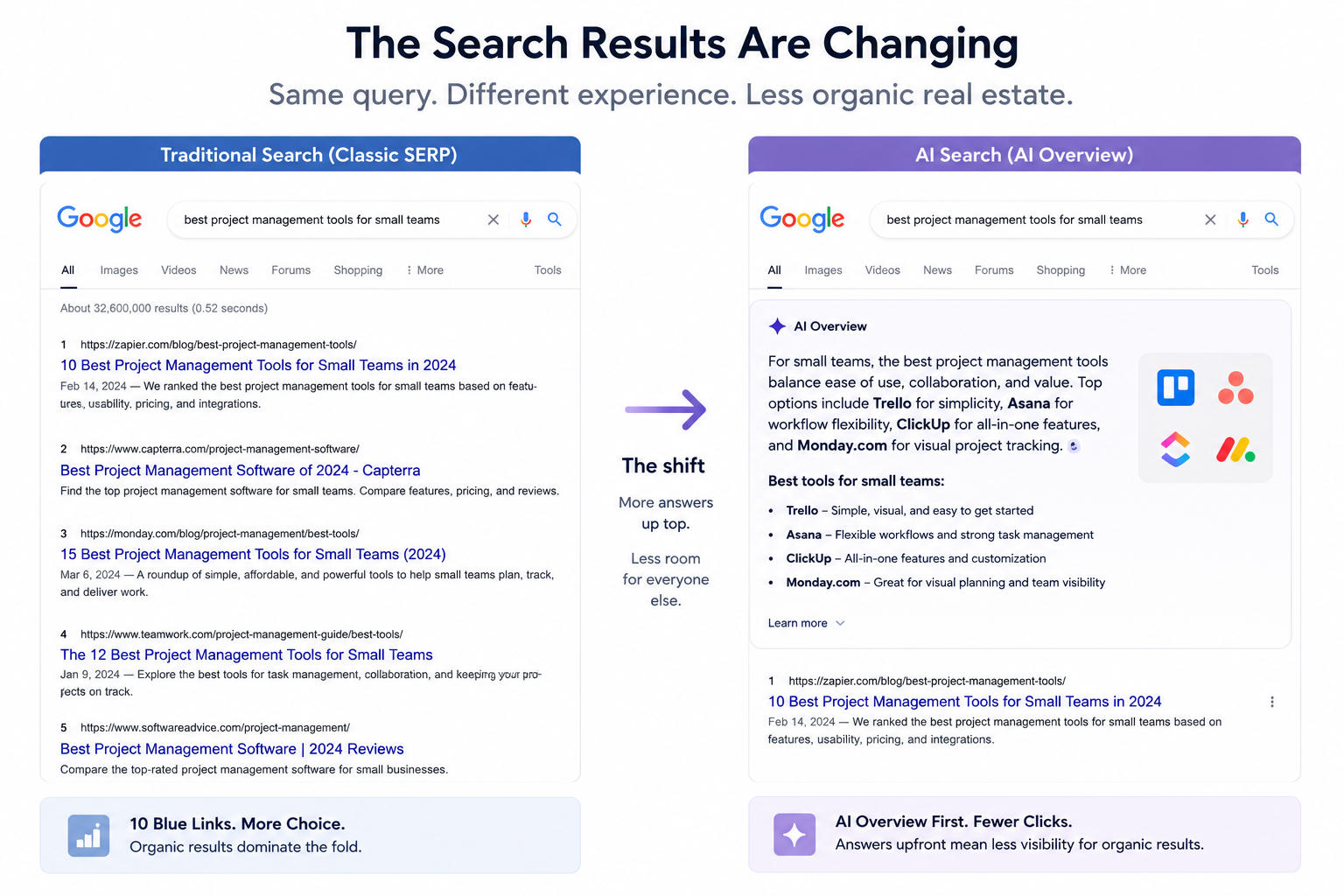
There is a layer the 2024 version of this article would not have included. AI Overviews now appear on close to 99% of informational searches in Google according to recent industry analyses. ChatGPT, Perplexity and Claude are answering questions that used to send users to a list of ten blue links. For some small businesses, the customers who would have read a blog post in 2024 are reading an AI-generated summary in 2026.
This does not mean SEO is dead. It means SEO and AI search optimisation are now the same project. The content that ranks in classic search is also the content AI systems retrieve and cite when generating answers. The difference is structural:
For a Melbourne small business starting an SEO program in 2026, the honest read is this. If the program is not AI-search-ready from day one, it is a 2023 product being sold in 2026. Anyone offering AI search optimisation as a separate service to be added later has not caught up with how retrieval actually works now.
The four preconditions are a useful self-check. Run your business through this list:
If any one is missing, the answer is 'not yet' rather than 'no.' Not yet usually means three to twelve months of work on whatever the missing piece is. Stabilise the offer. Build the content habit. Get fulfilment capacity ready. Then come back to SEO when the foundations are there.
If you would like to talk through where your business sits and whether SEO is the right call, we are happy to have that conversation. Sometimes the honest answer is yes, sometimes it is no, sometimes it is wait six months and revisit. We will not try to sell you something you are not ready for, and we do not lock anyone in. The right time to start is when SEO will actually work for your business, not when an agency needs to hit a quarterly target.