





You've been told you need SEO. You've read the article that suggested a 50-hour content audit. You've seen the spreadsheet with twelve tabs of keyword research. You closed the laptop and got back on a job.
That's the gap most SEO for tradies advice doesn't close. The advice gets written for businesses with marketing teams. Tradies have a quote to write before dinner.
This article works backwards from a real time budget: 30 minutes a week. That's enough to hold a tradie's local search position, if those 30 minutes go on the right things. CJ Digital is a Hawthorn agency working with 50+ Melbourne SMBs, including building and trade clients. The routine below is what we'd write on a sticky note for every plumber, sparky, or carpenter who asked.
If you've already read our foundation piece Local SEO for plumbers, electricians and builders: how Melbourne tradies get found, this one is the practical follow-up. If you haven't, that's the place to start.
For most service-area trades, yes. A tradie running a plumbing or electrical business in Pakenham, Werribee, or Frankston depends on local enquiries. Those enquiries start with someone typing ‘plumber near me’ or ‘emergency electrician’ plus a suburb into Google. If your business doesn't show up in the local pack or map listings for those searches, you're invisible to a real share of the demand in your area.
There are caveats. If you work mostly through trade portals like Hipages or Oneflare, your enquiry pipeline already runs through a third party that does its own SEO. If you work mostly as a subcontractor on commercial sites, your jobs come through a different channel and direct search visibility matters less. Most tradies aren't in either group. They mix some portal work, some word-of-mouth, and some direct enquiries, and the direct enquiries are where SEO earns its keep.
There's another split worth naming. Emergency searches and planned-work searches behave differently. A burst pipe at 11pm gets typed into Google as ‘emergency plumber’ plus a suburb. A bathroom renovation gets searched over a month, with terms like ‘best plumber Pakenham reviews’ or ‘plumber recommendations Berwick’. Tradies who handle both kinds of work need to show up for both. Tradies who only take planned work can focus narrower and cover fewer search patterns.
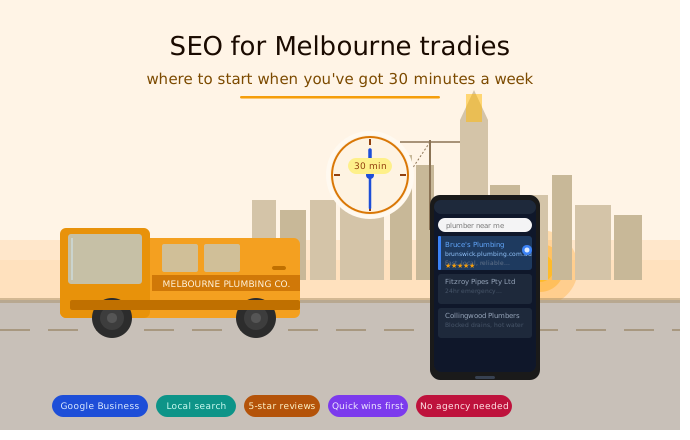
Four tasks, rotated weekly. Each one runs for 30 minutes once a month. By the end of the cycle, the four foundations of local search visibility have all been touched without a job getting cancelled to make it happen.
That's a real 30 minutes. Set a phone timer if it helps.

The 30-minute routine covers the work only you can do. The rest needs technical skill or sustained attention that a working tradie can't sensibly carve out. That's the work an SEO agency for tradies should be doing on the retainer.
The split below is the cleanest test of whether the agency relationship is fair. If they're charging you for the left column, you're paying for work you can do in 30 minutes a week. If they're asking you to do the right column, they're not delivering the retainer.
Four platforms come up repeatedly when a Melbourne salon owner is choosing between booking systems in 2026. The platform you pick matters more than where you embed it on your website.
| What stays with you | What an agency does better |
|---|---|
| Photos and captions from your jobs | Technical SEO (site speed, schema, mobile rendering) |
| Texting customers for reviews | Local link building and citation cleanup |
| Service-page edits in your customer language | Tracking Google's algorithm shifts and adjusting strategy |
| Replying to reviews in your own voice | Local pack monitoring across your service suburbs |
What a fair retainer for an SEO agency for tradies looks like in practice: a written list of what's being done each month, a monthly report you can read in five minutes, and access kept under your name on Google Business Profile, Search Console, and Analytics. If the agency wants to own those accounts on your behalf, that's a flag. The accounts should always be yours, with the agency added as a manager and removable in one click.
Some of the most popular SEO advice for tradies is now a quiet liability. These are the moves that look productive but compound the wrong way.

Six months of consistent 30-minute weeks is the realistic horizon for visible movement in the local pack for a defined service area. Twelve months of consistency compounds into a position where the business is choosing which jobs to take, not chasing them. Inconsistent effort produces noise: rankings move up, then back, then sideways, and you never know whether the routine is working.
The variable is service-area density. A plumber in Sunbury competing against three other plumbers will see results faster than a plumber in Frankston competing against twenty. Same routine, different timeline. The work is the same. The patience required is different.
What does visible movement look like in concrete terms? Your Google Business Profile views climb from a few hundred a month to a few thousand. Your local pack position for your top three searches shifts from unranked or page two to positions 1–3 in the map listings. Your enquiry volume from organic searches doubles or triples. SEO for tradies is measurable when you keep a baseline; the pattern is hard to read when you don't.
A tradie SEO retainer in Australia typically runs between $800 and $2,500 per month, depending on service area, competition, and scope of work. Below $800, the work is usually template-driven and won't move the needle in a competitive Melbourne suburb. Above $2,500, you should be getting a measurable ROI report each month. If you can't see what's being done for the spend, you're paying for activity, not outcomes.
SEO is the long-term practice of being found by customers searching for your trade in your service area. Google Ads is the paid shortcut that puts you at the top of those searches today. SEO compounds: 12 months of consistent effort lifts your visibility for years. Ads stop the moment you stop paying. Most tradie businesses use both. Ads in the first six months while SEO builds, then ads scaled back as organic visibility takes over.
Tradies should do the routine work themselves and hire an agency for everything else. The 30-minute weekly routine in this article (photos, job posts, reviews, page checks) needs you, because the customer language and the job photos can't come from anyone else. Technical SEO, link building, schema markup, and local pack monitoring sit better with an agency. The split is the cheapest test of whether your agency is delivering value.
Yes. Google's local search uses service-area signals, not just your physical address. A plumber based in Cranbourne can rank for ‘plumber Pakenham’ or ‘plumber Berwick’. That works if the Google Business Profile lists those service areas, the website has dedicated suburb pages, and recent jobs there are documented in posts and reviews. Distance still matters: a 20km radius is realistic, 90 minutes away is not.
The clearest signal is enquiry volume: are more customers calling, texting, or filling in your contact form than three months ago? Beyond that, three numbers tell the story: your Google Business Profile views, your local pack position for your top three service-area searches, and your review count. If those three are moving up over a six-month window, the SEO is working. If they're flat, something needs to change.
Most tradies don't need a traditional blog, but they do need a stream of job documentation posts on their website and Google Business Profile. The difference matters. A blog post titled ‘5 tips for hiring a plumber’ doesn't help a tradie business. A short post showing a hot water service replacement in Officer with three photos and a caption does. The format is more like a portfolio than a magazine.
Tradies have natural quiet periods. A landscaper between Christmas and the end of school holidays. A residential builder when interest rates have just moved. An air-conditioning specialist mid-winter. The trades have their own off-seasons, and most tradies treat them as time to catch up on quotes, do paperwork, or take a week off.
Quiet periods are the single best moment for the catch-up SEO move. The 30-minute weekly routine is the maintenance that holds your visibility steady. The quiet period is for the bigger moves. That means a proper rewrite of a service page, photographs of older jobs you never documented, and review requests to the long-time customers you keep meaning to ask. One focused week, on top of the weekly routine, creates the second-year compound that no agency retainer alone delivers.
If you want to talk through what an agency adds on top of a routine you can already run, get in touch. The 30-minute weeks are yours to start now.