





No. A high search volume does not make a keyword worth chasing on its own. What matters is who is searching the term and what they do next. Two searches can carry the same monthly volume and be worth completely different amounts. At CJ Digital, a digital marketing agency in Hawthorn, we watch Melbourne business owners pick the biggest number on the list and spend months chasing a term that was never going to bring them work.
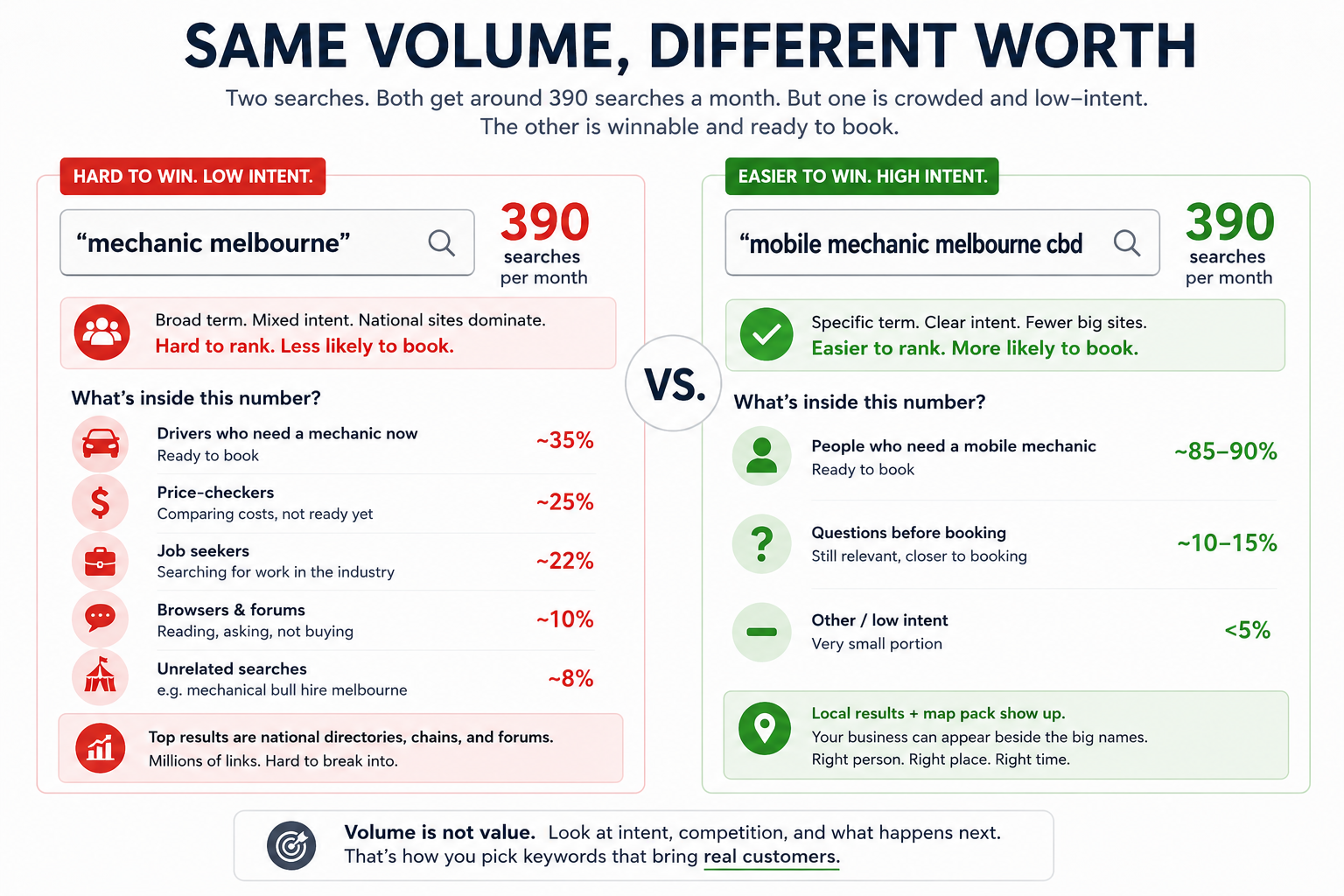
Take a mechanic in Melbourne. They look up what people search and see "mechanic melbourne" getting around 390 searches a month. That feels like the term to win. Then they spot "mobile mechanic melbourne cbd" sitting at about 390 a month as well. Same number. The second one is worth far more, and it's easier to win. The reason is sitting inside that first number. If you're unsure how to assess a term beyond search volume, here's how to determine whether a keyword is worth ranking for.
A search volume counts everyone who typed the words, not just the people who want to buy. What separates a good keyword from a weak one is the reason behind the search: a driver who needs a service, against someone who happens to use the same words. A broad term like "mechanic melbourne" pulls in a wide mix, and the number treats them all the same.
Look at the searches around "mechanic melbourne" and you find:
Only the first group will ever book a job. The headline number can't tell you how big that group is, so it flatters every term equally.
Some of those searchers are useful but slow. Someone checking what a service should cost might book in a month, or might be ringing round ten workshops first. The driver searching for a mobile mechanic near their suburb is usually ready this week. A broad term blends the slow and the ready into one figure.
The most-searched term in a category is usually the one every big site already owns. For "mechanics melbourne", the first page of Google is filled with national directories and franchise chains, not local workshops. AutoGuru sits at the top, a couple of national chains are up there too, and a Reddit thread ranks above most real mechanics.
There's a second catch. In Australia, "mechanics melbourne" only draws about 110 searches a month. So the hardest term in the category, the one guarded by national sites, is also a small and mixed audience. The effort is high and the prize is thin.
A small workshop with a handful of links is not going to outrank a directory with millions of them. You can spend a year chasing "mechanics melbourne" and still sit on page three, beneath businesses that aren't even your real competition. After 12 years and more than 50 Melbourne clients, this is the trap we see most. The term that looks like the prize is often the one a small business has the least chance of winning.
The better news for a small workshop is that local searches usually show a map with nearby businesses above the main results. That map is where a Melbourne mechanic can sit beside the big names, without having to out-muscle them on links. It rewards a complete, accurate listing far more than a high-volume keyword.
Yes, often. A search with lower volume can be worth more when every person typing it is ready to book, and when the term is one you can win. The strongest examples are specific: a service, a car make, or a suburb.
For a Melbourne mechanic, the searches that bring real work look like this:
Each of these is easier to rank for than the broad term, because fewer big sites bother with them. And the person typing them has already made up their mind about what they want. They are not browsing. They are looking for someone to call.
Car makes work the same way. "Audi mechanic melbourne" pulls about 260 a month and "vw mechanic melbourne" about 210, and both are low-competition. A workshop that services European cars can rank for several of these at once. Five specific terms, each easy to win, add up to more booked work than one broad term it never reaches.
Put the broad term next to two specific ones and the gap shows:
| Example search | Who is typing it | How winnable | Likely bookings |
|---|---|---|---|
| "mechanic melbourne" (about 390 a month) | Drivers, price-checkers, even people after mechanic jobs | Hard. National directories and chains own the top spots | Some, watered down by non-customers |
| "mobile mechanic melbourne cbd" (about 390 a month) | A CBD driver who wants someone to come to them | Winnable. Few big sites bother with it | Most who search it want to book |
| "diesel mechanic melbourne" (about 110 a month) | A diesel owner who needs a specialist | Winnable | Steady, ready-to-book work |
Look at the top two rows. Same search volume, about 390 a month each. One is a hard fight for a mixed crowd. The other is a winnable term full of people ready to book. The number on its own told you nothing useful. This is also why some businesses rank on Google but their phone isn't ringing.
Judge a search by who is behind it and what they do next, not by the size of the number. Three questions sort the worthwhile terms from the ones that only look good:
Picking the right searches is the heart of good SEO, and it's where a lot of SEO Melbourne campaigns go wrong. A handful of specific, winnable searches will usually bring more work than one popular term you may never reach. This is also why we don't lock clients into long contracts. As you learn which searches bring the calls, the plan should be free to shift with them. The big term still has a place over the long run. It just shouldn't be the whole plan.
A workable list for that mechanic might be a couple of suburbs they serve, one or two specialties like diesel or European cars, and "mobile mechanic" if they offer it. That mix brings steady calls while the broad term builds slowly in the background. You make ground every month instead of waiting years for one payoff that may never come.
The searches worth winning change from suburb to suburb. A mechanic in Footscray and one in Brighton chase different terms, because their customers search in their own area and their own words. The same holds whatever you sell. The big, obvious term is rarely the one that fills your week. The specific searches your customers really type usually are. If you want help finding them, talk to CJ Digital and we'll go through your numbers with you and pick the few worth winning first.
Search volume is one useful sign, not the whole story. It shows how many people search a term, but not who they are or whether they will buy. A smaller search full of ready customers can beat a big one full of browsers.
The value of a search comes down to intent: how close the person is to buying. Someone searching "mobile mechanic melbourne cbd" wants to book. Someone searching "mechanic jobs melbourne" wants a job. Same words, very different worth.
Yes, but rarely first. Popular terms suit a long-term plan, once the specific, winnable searches are already bringing calls. Chasing the big one first usually burns time and money for little return.
Start with how your customers describe what they want, including your suburb, your specialty and "near me". Those plain, specific phrases are usually lower in volume and far higher in intent than the obvious term.